The Story Of Anna Margaretha Meisenheimer Duke
By: John Earl Ferguson Misenheimer, II
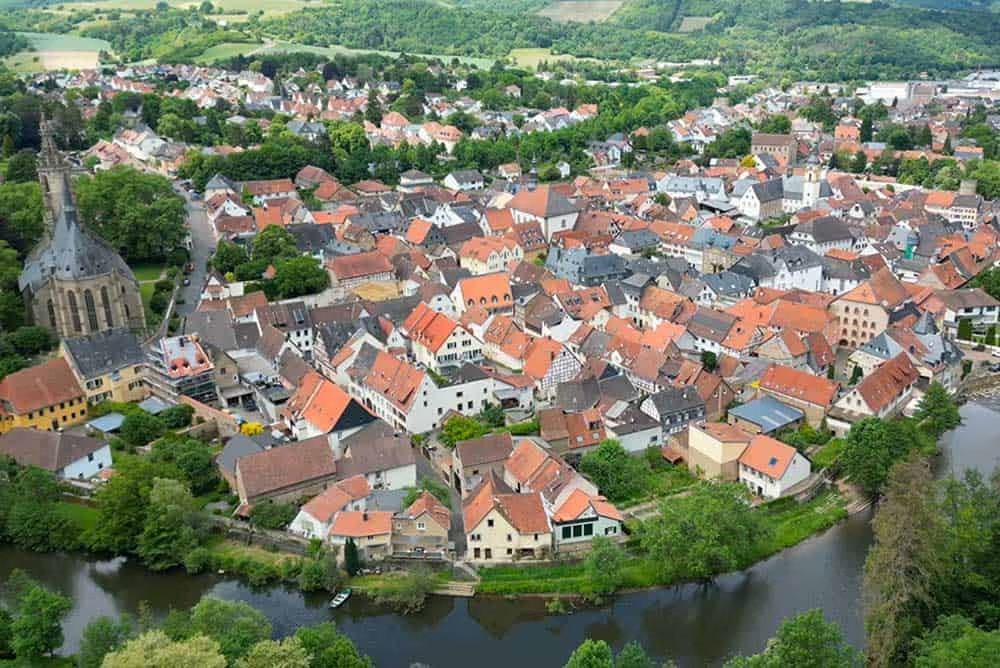
Anna Margaretha Meisenheimer was born on January 13, 1754, in Pennsylvania, to Johann Jacob Meisenheimer and Anna Margaretha Reiter Meisenheimer. Anna's father, Johann Jacob Meisenheimer, was born on August 15, 1718, in Waldalgesheim in the Pfalz-Rheinland region of Prussia, and now in western Germany near the Rhine River. Johann Jacob came to Philadelphia, Pennsylvania, after making his way from Waldalgesheim on the Nahe River. He went to Bingen on the Rhine River. In Bingen, the river Nahe empties into the Rhine Gorge.
The Town of Bingen predates the Roman settlement, dating back to the Celtic era of this region. Additionally, Bingen was a significant Roman military base, featuring a Roman road. Therefore, it is a real possibility for both early Celtic and Roman ancestry in the family tree of Johann Jacob Meisenheimer. Yet, there has always been a desire for Meisenheimer relatives to travel to new places. The surname of Meisenheimer is known as a location name, because it is derived from the city named Meisenheim am Glan, in the same Pfalz-Rheinland region as the Town of Waldalgesheim. The meaning of "am Glan" is "on the Glan," a tributary of the Nahe River that then flows into the Rhine River beside Bingen at the Rhine Gorge. These waterways, including creeks and tributaries that feed into the Nahe and Rhine Rivers, are part of the journey of the Meisenheimer surname, and how it originally came into being as our family surname, too! Just as water moves in a stream, people also move from one place to another.
Therefore, a Meisenheimer is someone from Meisenheim am Glan, and that is why the "er" is added to the town name of Meisenheim to signify the origin of a group of people from a real place or location. The same idea applies in America when calling a person a "New Yorker," because they are from New York. All surnames become a person's identity, and surnames are derived from various sources, like a place, as in a town, a physical feature, as in Armstrong, a trade or occupation, as in a Baker or a Smith, and numerous other naming patterns as well.
Did Johann Jacob Meisenheimer wonder where the waterways carried all the water to beyond the Rhine River, and the old world that he knew in the Pfalz-Rheinland region? We can imagine that he was hearing stories of the New World, and how a man could own land and build a new life with freedom and liberty, too! William Penn was advertising to the German-speaking people of the Pfalz-Rheinland region to come to the Colony of Pennsylvania, and he would sell them land to build a home, too! Just as the ocean's tide shifts to flow in the opposite direction, the New World beckoned to these German-speaking people, including Johann Jacob Meisenheimer, prompting them and him to leave the Old World they had known for generations, from which they derived their names.
Johann Jacob Meisenheimer, at the age of 23, said his final farewells to his relatives and friends that he had known from his youth to begin a new adventure from the Old World toward the New World. He traveled down the Nahe River from Waldalgesheim, the place of his birth, to Bingen on the Rhine River. Next, Johann Jacob made his way down the Rhine River to the port city of Rotterdam to purchase and book passage on a ship bound for the New World, and he must have been in wonder at how large the world really was beyond the Pfalz-Rheinland region he had always known growing up. Johann Jacob's sailing vessel or ship went from Rotterdam to the Isle of Wight, into the port of Cowes off the southern coast of England, because it was ruled by the British Crown there, too. Then the real ocean journey began across the Atlantic on the ship named "Lydia," and the English Captain carefully recorded in the ship's passenger list both the name of Johann Jacob Meisenheimer and his age of 23 years old. Finally, the ship arrived in Philadelphia, Pennsylvania, on September 19, 1743.
Johann Jacob Meisenheimer must have arrived in the New World with financial means, as he was exempt from serving an indenture for seven years since his passage was already paid for in Rotterdam. From the beginning of his arrival, he experienced the many freedoms and liberties granted to him as a new citizen of the British Empire. Even in Philadelphia, there is a bell called the "Liberty Bell" that rang the sounds of freedom throughout the whole country on Independence Day.
Since Johann Jacob Meisenheimer enjoyed freedom upon arrival, he was able to secure the affections of a beautiful young lady named Anna Margaretha Reiter, and he proposed to her as well. Anna Margaretha Reiter surely accepted and agreed to marry Johann Jacob Meisenheimer. On November 16, 1746, Johann Jacob and Anna Margaretha Reiter were married at Augustus Evangelical Lutheran Church in Trappe, Philadelphia County, now Montgomery County, Pennsylvania, as recorded in the church's history. Officiating was Pastor Heinrich Melchior Muhlenberg, the founding patriarch of the American Lutheran Church.
The year 1754 was significant for many reasons, as it marked the beginning of a new life and a future with renewed freedom and liberty for the newborn baby Anna Margaretha Meisenheimer, who was born on January 13, 1754. It is interesting to see that the daughter of Johann Jacob Meisenheimer and Anna Margaretha Reiter Meisenheimer was given her mother's first and middle name, and the ancestral surname of Meisenheimer, to remind her where she came from. The male surname, as is tradition, is still passed on to the children and offspring even to this day. One can imagine Johann Jacob Meisenheimer telling his daughter Anna Margaretha Meisenheimer, as she grew up, the heritage of her surname back in the Old World, and at the same time teaching her about the blessings of freedom and liberty in the New World, too!
In 1754, another event of international importance occurred in Pennsylvania, involving a young Lt. Col. George Washington, who played a key role in starting the French and Indian War. Therefore, the story of newborn baby Anna Margaretha Meisenheimer and her life will be linked with the significant achievements of George Washington as they both grow into mature adults.
The French and Indian War, as it is known in America, was also called the Seven Years War in Europe, and it ended in 1763, with the map of the whole world being redrawn to give the spoils of War to the British Empire, as they were victorious over France and Spain. In America, the Colony of Florida was ceded to the British Crown and added to the other colonies along the Atlantic coastline. As the British Empire expanded, the government had to manage its new territories with military strength, shipping troops to various global destinations, including America. Additionally, new taxes were introduced to help fund the expansion of the British Empire.
Yet in America, the cry went out, "No taxation without Representation," because the British Parliament did not include any elected representatives from America. This now had the appearance of denying the freedoms and liberties that British citizens in America, both those who came from the Old World and those born as natives in the New World, had long enjoyed.
During these same early years, the young girl Anna Margaretha Meisenheimer had grown into a young lady and became engaged to Johannes Sabastian Schunck (later changed to Duke). Then they were married on December 1, 1772, at New Hanover Lutheran Church in Philadelphia County, Pennsylvania. There is no evidence that Anna Margaretha Meisenheimer ever changed the spelling of her maiden surname from Meisenheimer, the original German spelling, and this was true for her brother Peter Meisenheimer, who kept the original German spelling of their father's surname from the Old World. This is an attempt to present historical facts for the reader's consideration before adopting the change that other siblings have made to the more Anglicized version of Misenheimer, which is commonly used in modern times, except for the descendants of Peter Meisenheimer, who have retained the Old World spelling in the German language. Therefore, this researcher is using the original in this article on Anna Margaretha Meisenheimer.
By 1775, events were speeding to the start of the American Revolution, and on April 19, 1775, the first "Shot heard Around the World" was fired by the British Troops coming out of Boston into the countryside at Lexington and Concord, Mass. Now, new cries are coming from the people, echoing Patrick Henry's famous words: "Give me Liberty or Give me Death!" There were attempts to prevent the tide of the coming War and to work on a peace, but to no avail.
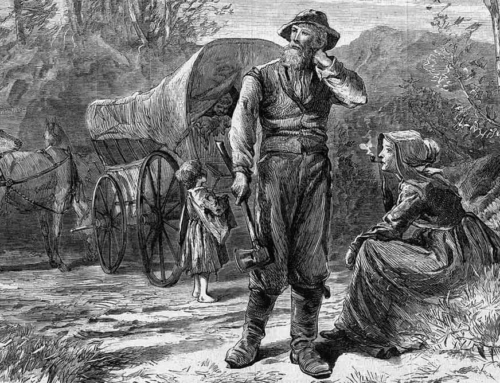
Johann Jacob Meisenheimer, the father of a large family of ten children with five boys and five girls, wanted to shepherd his flock and move them into a new community, most likely for economic reasons. Pennsylvania was already overflowing with many people coming from the Old World to the New World, and the opportunity to sell land at a higher price in Pennsylvania made perfect sense, especially since this trend continued into 1775. There were already established German communities in the backcountry of the Piedmont of North Carolina, and many former friends had relocated south in the previous three decades of the 1740s, 1750s, and 1760s. The reason to move south was to find more affordable land and keep his whole family together in one place. Therefore, the path from Pennsylvania this time for a new adventure was called the "Great Philadelphia Wagon Road," and it extended into North Carolina, South Carolina, and even as far south as Georgia.
The time had come to move in 1775, even with all the rushing flood of Revolution streaming like water through the talk of the day! People still had lives to go forward, even in a changing world, because the changes were being felt in the South, too.
The last known and proven historical record for the family of Johann Jacob Meisenheimer in Pennsylvania was that of the baptism on May 14, 1775, of the daughter of Anna Margaretha Meisenheimer Schunck with Johann Jacob Meisenheimer and Anna Margaretha Reiter Meisenheimer, both grandparents, as sponsors at New Hanover Lutheran Church in Philadelphia County, Pennsylvania.
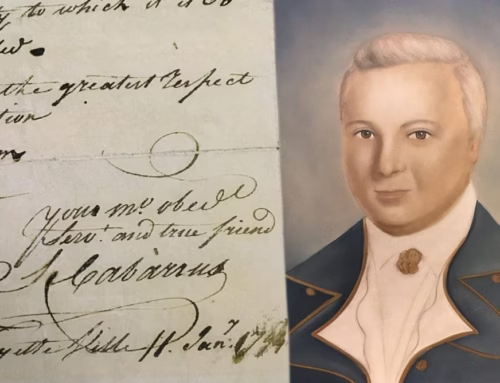
In the direction of their new home, soon to be in Mecklenburg County (now in Cabarrus County), North Carolina, the news of the Battle of Lexington and Concord arrived in Charlotte on May 19, 1775. According to various eyewitness accounts, the Men of Mecklenburg allegedly created a document called the Mecklenburg Declaration of Independence, which was signed on May 20, 1775, according to traditional accounts. If you believe it or not, there is no doubt about the Mecklenburg Resolves, created on May 31, 1775, and published in several newspapers of the time.
One of the leaders of the community associated with the Saint John's Lutheran Church congregation was Lt. Col. John Phifer, who commanded the Patriot troops from Saint John's. According to the various accounts, Lt. Col. John Phifer was a signer of the Mecklenburg Declaration of Independence on May 20, 1775.
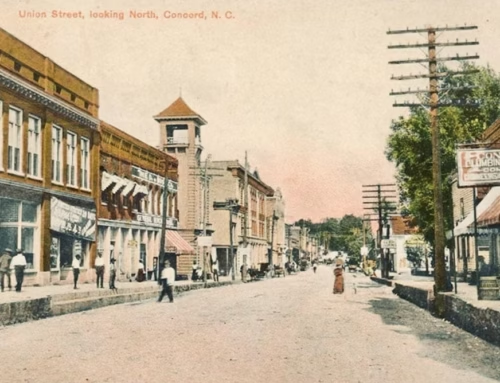
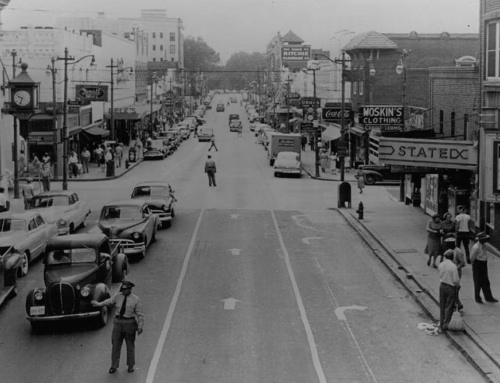
During the 1775 summer months, the whole family, all ten children and grandchildren of Johann Jacob Meisenheimer, including his daughter Anna Margaretha Meisenheimer Schunck, travelled down the "Great Philadelphia Wagon Road," and into Mecklenburg County (now Cabarrus Co.), North Carolina. They established their home in the German settlement at Saint John's Lutheran Church, which is now located between Concord, N.C., and Mount Pleasant, N.C., in the northeastern part of what is now Mecklenburg and Cabarrus counties.
One year later, on July 4, 1776, the Continental Congress adopted the Declaration of Independence, drafted by Thomas Jefferson. In later years, Thomas Jefferson initiated a debate with John Adams over the existence of a Mecklenburg Declaration of Independence on May 20, 1775, which occurred more than a year before his own Declaration of Independence. We should be honored that such as these two Founding Fathers took an interest in Mecklenburg County, North Carolina in the first place.
President George Washington actually visited Cabarrus County in May 1791, and so many of the citizens turned out to see him. It is easy to imagine that Anna Margaretha Meisenheimer Duke, in all likelihood, was among many citizens who would have lined the "Great Wagon Road" as our nation's first President and former Revolutionary War General passed. It must have been like our modern 4th of July Parades, with people everywhere coming to see one of the most famous persons in the world, both then and now. Even the whole Meisenheimer family surely must have attended the arrival events of Mr. President Washington, because he did spend the night at a local tavern and inn called "Red Hill."
Colonel Martin Phifer, at the time of the Revolutionary War, was a Captain in the Cavalry and was stationed at Valley Forge, Pennsylvania, with the Continental Army throughout the winter. Col. Martin Phifer was the operator of the "Red Hill" Inn and Tavern, so it must have been an absolute pleasure to host his most crucial former commander of the Continental Army in his own home, too.
Regardless of your personal beliefs on this matter, the facts are that once the Revolutionary War got started, the men and women, both Scot-Irish and Germans, in the seven Presbyterian Churches and the two Lutheran Churches at Morning Star and Saint John's all contributed to fighting for what they believed in, their rights for freedom and liberty! All five sons of Johann Jacob Meisenheimer gave Patriotic service in the Continental Army and the local Mecklenburg Militia, and one son, Johannes Meisenheimer (also known as John Misenheimer), sold supplies to the American Army. Please see the previous Golden Nugget articles on his story, and the Memorial Marker Dedication at Saint John's Lutheran Church, too. Additionally, all the siblings of Anna Margaretha Meisenheimer Schunck were married to Patriot Soldiers in the American Revolution. Currently, research is ongoing to locate documentation on Johannes Sebastian Schunck (later changed to Duke) to prove his patriotic service. However, even without documentation that could have been lost or destroyed, no assumptions can be made in either direction regarding his service. If he had been a loyalist, there would be court papers to that effect; however, nothing has surfaced to that effect. Was he neutral, maybe, but I think that would be hard to do, surrounded as Johannes Sabastian Schunck (later changed to Duke) was by all the siblings and their spouses who supported the "Cause of Liberty and Freedom!" Therefore, we may never know this side of Heaven.
Johannes Sabastian Schunck (later changed to Duke) and his wife Anna Margaretha Meisenheimer Schunck moved with her father's whole extended family to Mecklenburg County, now Cabarrus County, N.C., where they lived and died.
The children of Anna Margaretha Meisenheimer Schunck and Johannes Sabastian Schunck (later changed to Duke) are: (1) John Sabastian Duke, Jr., born in Pennsylvania, died 1815, Cabarrus/Rowan County; (2) Johann Jacob Duke, born September 19, 1773 in PA, died and buried in Greenlawn, China Grove; (3) Anna Margaretha Duke, born January 3, 1775 in PA; (4) Elizabeth Duke, born 1778; (5) Mary Ann Duke, born November 2, 1782, died April 15, 1846, buried at Lower Stone Church, Rowan County, N.C.; (6) Katherine Duke, born November 2, 1782, died April 5, 1846, buried St. John's Lutheran Church, Cabarrus Co., N.C.; and (7) Thomas Duke, born 1788, died 1815, Rowan County (?), buried at Lower Stone.