Concord, NC: Into The Third Century (1997 – 2019)
Written by Clarence Horton (2019)
Two hundred and twenty-three years of success is a respectable amount of time for a city, and the record of your accomplishments cannot help but raise the question, "Where do you go from here?" Not long ago, the bridge on Cabarrus Avenue, which crosses the railroad, was named for community leader Allen Small, a city councilman and educator. Mr. Small served as Principal of Logan High School before integration, then as Principal of Coltrane-Webb Elementary and Wolf Meadow Elementary. After he died in 2006, his widow, Ella Mae Small, herself a retired teacher, filled his position on the City Council. If Mr. Small were answering the question about our accomplishments today, I suspect that he would give his traditional answer: "Things are looking up!"
And "looking up," they were in 1997. Under the leadership of Mayor George W. Liles and an able city council and manager, the CityCity had completed several large annexations in 1986, 1991, and 1995; worked hard to identify the future needs of the CityCity and the next generation of its citizens; and had begun the patient planning necessary to meet those needs. Having passed through eras dominated by agriculture and then by King Cotton, Concord entered its modern era, a time of growth and diversification, with the eyes of her leaders and citizens focused on the future. The struggle to open the Regional Airport in the early 1990s was validated by its successes and its appeal to the racing industry and businesses considering a move to the area. The great roads passing through the County and near Concord, which made the area easily accessible, the proximity to Charlotte and its economic opportunities, and the quality of life in the Concord area began to open economic doors. Robert Lee Mathis, a Navy veteran and community leader, retired in 1997 after serving as the first African-American City Councilman for 18 years. In 1998, a distinguished African-American lawyer, Johnnie B. Rawlinson, a native of Concord, was named to the U.S. District Court in Nevada; Judge Rawlinson was elevated to the Ninth Circuit Court of Appeals in 2000, becoming the first woman of color to serve on that court.
In 1999, all these factors came together, leading to the welcome opening of a mega-mall by the Mills Corporation on Interstate 85, near the Motor Speedway, the Airport, and the city-owned Golf Course. It is little wonder that it is now one of the leading tourist destinations in the entire State, combining, as its creators promised, both shopping and entertainment.
Concord and Cabarrus County would soon need all their vision and determination to deal with some of the mixed economic news of the new century. In 2003, Pillowtex Corporation (purchaser of the former Cannon Mills Company and its local plants) finally had to close its doors, resulting in massive local layoffs and losses. Although Phillip Morris had taken action in 1991 to expand its Concord plant at a cost of some $400 million, in the new century, the tobacco industry was dealing with massive lawsuits and a shrinking number of American smokers.
Fortunately, a local industry, S & D Coffee Company - a coffee bean roaster and distributor founded in 1927 – had established a growing footprint not only in North Carolina, but in the nation. S&D became well known for the quality of its coffee products, supplying some of the significant American restaurant chains. The business expanded to include Tea as part of its product line and its company name, but management elected to maintain its headquarters in its familiar Concord location.
The local hospital, Cabarrus Memorial, became part of NorthEast Medical Center (now Atrium Health), expanded dramatically in size and services, and provided additional job opportunities for local workers. Although the regional Airport was relatively new, it quickly became an essential part of the area's attractions. Concord Telephone Company, founded in Concord by the Coltrane family in 1897, was a significant employer and service provider as the third century began and continued to be after its purchase by Windstream.
In 2004, Concord was honored with the All-American City Award. So, despite unavoidable losses, the balance sheet remained positive in Concord and helped mitigate the difficult economic times we usually call "The Great Recession," which began in 2008. Despite the effects of the Recession, Concord continued to grow. The 2000 Census recorded a population of almost 56,000, which grew to more than 79,000 in 2010. By 2015, Concord was about 60 square miles in area and ranked 16th-fastest-growing among U.S. cities. With that growth, however, came the need for similar growth in city buildings and services.
NEW CITY POLICE HEADQUARTERS OPENED IN 2006
Planning for the new century of service identified the need for a modern headquarters for a modern police department. Architects designed a building at the intersection of Market Street and Cabarrus Avenue to meet law enforcement needs and complement downtown Concord's traditional look and feel. A highlight of the City's 210th Anniversary in 2006 was the grand opening of the new quarters to the public on October 9, 2006.
The new building had 65,000 square feet and cost more than $14 million, including land, site preparation, construction, and furnishings. A $1 million grant to the Department allowed implementation of an innovative records management system. It provided space for 170 sworn police officers, as well as numerous support personnel, including crossing guards, code enforcement officers, records personnel, and administrative support staff. It replaced the former 11,000-square-foot Market Street headquarters, opened in 1973 at a cost of some $350,000, and was designed to house about 50 people.
REV. DONALD ANTHONY HONORED
Rev. Donald E. Anthony, minister at Concord's Grace Lutheran Church since 1997, continued his community activities. In 2014, he won the Kannapolis City Schools Champion for Children Award. The following year, Rev. Anthony chaperoned Cub Pack No. 134 on its visit to Selma, Alabama, in March 2015, on the 50th Anniversary of the civil rights movement.
NEW CONCORD CHIEF OF POLICE GARY GACEK APPOINTED IN 2015
In July 2015, Concord welcomed its newest Police Chief, Gary Gacek, and his family, as they moved from Milwaukee. Chief Gacek began his law enforcement career in 1990 in Milwaukee and built a solid resume, including a Master's Degree in Public Service, while rising to the rank of Captain in the Department. Leaving Milwaukee, with a population of 600,000, brought its own set of challenges, but he thought the mild climate and opportunities for growth well compensated for it. Understanding the need to establish goals and expectations, Chief Gacek spent much of his first weeks in office meeting with his command staff and supervisors to do just that. After having the opportunity to assess those closest to him in the command structure, the Chief began scheduling public meetings and becoming highly visible in the neighborhoods that make up the Concord community, meeting with persons of influence and bringing police and the community closer together in their efforts against crime. In furtherance of his dedication to transparency and communication, the Department published, in 2017, the first 18 months under Chief Gacek's leadership, along with relevant statistics.
For the sixteenth year, Concord participated in the National Night Out in August 2017. Its goals include increasing awareness of crime and its prevention, garnering support for local anti-crime efforts, and strengthening partnerships between the community and police. The City also publicizes and supports local efforts to combat the opioid epidemic sweeping North Carolina. For the sixteenth year, Concord participated in the National Night Out in August 2017. Its goals include increasing awareness of crime and its prevention, garnering support for local anti-crime efforts, and strengthening partnerships between the community and police.
FIFTY YEARS OF COUNCIL- MANAGER FORM OF GOVERNMENT IN CONCORD (1965-2015)
On July 15, 2015, we celebrated the 50th Anniversary of the City Manager form of government in Concord. The Board of Aldermen (now the City Council) began discussing the possible change in the late 1940s, but Bradley Barker was not hired as the first City Manager until 1965. J. P. Francis succeeded Mr. Barker, serving from 1969 through 1973. William C. Hamann served for about 3 ½ years, followed by Jerry L. Gawltney, who served for about three years, from 1978 to April 1981. J. L. Greeson, the fifth manager, served from May 1981 through January 1985.
After five managers who served about 3 ½ years each, Leonard B. Sossomon and the present Manager, Brian Hiatt, have provided an essential continuity in the office since Mr. Sossomon began his service in February 1985. After Mr. Sossomon retired from the position in April 1998, Mr. Brian Hiatt was hired in October 1998, following 14 years as an assistant manager in Hickory. He drew on his extensive experience and sound judgment to ensure continued good government for the City.
Transportation needs have been a priority for the City during the past 50 years. In 1965, the Board of Aldermen agreed to ask the State Highway Commission to build an eastern bypass around the City, an eight-year process that resulted in Branchview Drive. Other projects include the George Liles Parkway Extension, the widening of Derita Road, and the Highway 49 Exit projects.
Mayor Scott Padgett often says that he believes Concord is the best-managed City in the State, perhaps the Region, and congratulated Mr. Hiatt on his "professionalism, experience, and integrity..." Mr. Lloyd Payne was Concord's newest Assistant City Manager, following service as Town Manager of Elkin and Lake Waccamaw, and a long career in the North Carolina Army National Guard.
COUNCIL MAINSTAYS DAVE PHILLIPS AND JIM RAMSEUR RETIRE AS THE NEW CITY HALL FOR CONCORD IS DEDICATED
2015 was a year that brought mixed emotions for the Concord City Government. Planners were proud of their new $227 million budget that maintained the same local tax rate. By mid-year, significant progress had been made on the new City Hall building on East Cabarrus Avenue, projected to open in December 2015 and to provide more than 76,000 square feet of space in a beautiful, modern building that would complement the older buildings in downtown.
City officials were anxious to have builders complete their work in time for the scheduled City Council meeting in December 2015, as long-time Council members Dave Phillips and Jim Ramseur wanted to attend their last Council meeting in the new facility. Both men had served faithfully on the City Council since 1995, during Concord's most significant period of growth and population expansion. Both were active in their community in many other efforts and organizations. Mayor Scott Padgett described them as his "friends and colleagues, [who] spent nearly as much time preparing to serve on Council as they did in office, which is why they were so successful and served for so long. Both are deeply rooted in the community, were successful in the business world, and have a passion for being civic-minded." Fortunately, construction completion estimates were accurate, and both men were able to attend a final meeting on the Council on December 10, 2015, in the new City Hall, where they participated in imagining, planning, and budgeting for, and sharing in some well-deserved accolades with Mayor Padgett, City Manager Brian Hiatt, and a host of dedicated coworkers.
POPULAR MAYOR SCOTT PADGETT DECIDES TO STEP DOWN
From the standpoint of Concord history, the most important story of 2017 was the decision of Mayor Scott Padgett to step down as the successful Mayor of one of the State's largest cities, completing four decades of public service beginning with his service as a school teacher, then principal, service on the Planning and Zoning Commission, the Concord City Council, then 16 years as Mayor. He was not going to rest on his laurels during his retirement, however, as Governor Roy Cooper had already appointed him to the North Carolina Local Government Commission.
Mayor Padgett looked back over his years at the helm, noting accomplishments that include steady growth and job opportunities for the City's citizens. With the 2003 closure of the textile mills that were descendants of the Cannon chain, the City nourished other economic engines, such as tourism, grounded in motorsports and the Speedway, as well as the attraction Concord Mills Mall holds for shoppers and sportspeople around the State. Mayor Padgett continued to emphasize the need for growth but also pointed out that maintaining a "day-to-day quality of life" for the citizens of Concord was equally important.
During his tenure, planning took place with one eye on the future. Recognizing a long-term need for water for manufacturing and for citizens, the City entered into an agreement with Albemarle and the City of Charlotte to purchase water from them. Other accomplishments include improvements to the Regional Airport, renovations to the public recreation center, opportunities for outdoor exercise and recreation on the greenways and in the parks, a new building to house the police department, and a new city hall. All of those improvements, and many others, have been financed in a fiscally sound manner, keeping the local tax rate at an attractive level. He always stresses, however, that the overriding guide has been to provide the best quality of life possible for not only those who were born here and want to remain and rear their children, but for those who live elsewhere but are drawn to this special area as a place to put down new roots and live out the American dream.
Mayor Padgett stepped down at a time when he was both popular and effective, but he was proud to continue serving his State on the Local Government Commission. Formed in 1931 to help our local governments cope with the challenges of the Great Depression, it has built a sound fiscal foundation for North Carolina's local governments. Three members of the Commission are appointed by the Governor, two by the General Assembly, and four are designated by state law. The Commission oversees the incurrence of debt and the issuance of bonds by units of local government.
Mayor Padgett left at a time when Concord was adjusting to both continued population growth and its current challenges, and to plan for the inevitable future needs of a growing region. According to census estimates as of July 1, 2016, Concord surpassed Asheville to become the 11th-largest municipality in the State. Concord's estimated population was 89,891 in 2016, while Asheville's was 89,121. From 2010 to 2016, Concord experienced an annual growth rate of more than 13%.
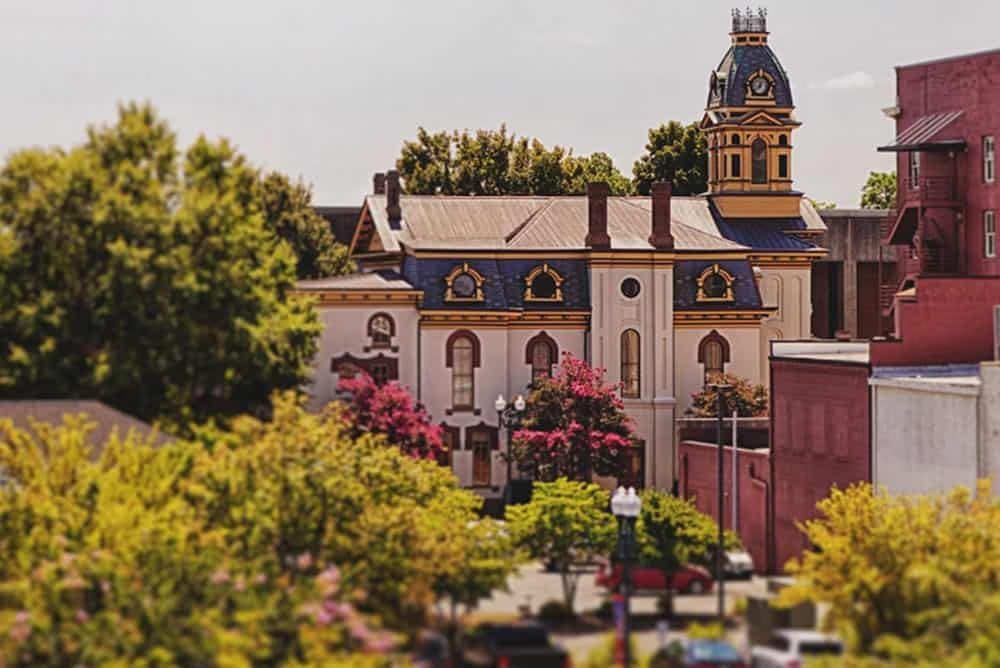
Among the attractions drawing new residents is the small-town feel to the growing area. The downtown area still boasts the historic Victorian homes and broad streets of an earlier time. Planners have shied away from skyscrapers and development that are inconsistent with downtown's mid-twentieth-century feel. Even the beautiful buildings that house City Hall and the Police Department seem to "fit in" with the City as it was a century ago. Designers have been working hard with County planners and architects to provide additional parking for a renovated Cabarrus County Courthouse. Designed to serve a smaller population, the present Courthouse will anchor downtown Concord, with a substantial addition behind it. The City budgeted $3 mCourthousea contribution towards the construction of a modern multi-level parking deck across South Union Street to provide parking for the newly-renovated Courthouse.
The City continues to Provide Those quality-of-life essentials, such as parks and recreational facilities, greenway expansion, outdoor programming, and planning to meet the needs outlined in the comprehensive Parks and Recreation Master Plan. As a result of that visionary planning, the Hartsell Recreation Center was recently reopened after an extensive $1.8 million renovation. Improvements include enhanced ADA accessibility and renovated exercise, fitness, and multi-purpose rooms open to the public.
For years, City staff have focused on aligning the City's goals and vision through budgeting and reporting. The City recently received the coveted Certificate of Achievement for Excellence in Financial Reporting for the 28th consecutive year. The award honors the City's annual financial report for the fiscal year ending on June 30, 2016. The award program was established in 1945, and encourages governments to go beyond minimum levels of generally accepted financial principles, and demonstrate the "spirit of transparency and full disclosure, and [to] recognize... governments that [achieve] that goal." Widely known for its reporting excellence, the City has received the Distinguished Budget Presentation Award from the Government Finance Officers Association for 15 consecutive years. Mayor Scott Padgett has often commented on the hard work required of City staff to translate the goals and priorities of city government into a budget that is fiscally responsible yet aggressive in meeting the City's present and future needs.
City staff sought to ensure constant communication with citizens through press releases, regular issues of Leisure Times that include all Parks and Recreation programs, city publications, and the weekly email summary of city news, "CityLink Newsletter."
NEW AVIATION DIRECTOR NAMED FOR CONCORD REGIONAL AIRPORT
Following Aviation Director Rick Cloutier's resignation, Concord embarked on a nationwide search for his replacement. Assistant Director Susan Green ably served as Interim Aviation Director during the extensive search, which yielded applicants both locally and nationwide.
In mid-July 2017, City Manager Brian Hiatt announced that the City had hired Dirk Vanderleest as Aviation Director, responsible for both operations and development at the busy Airport. Mr. Vanderleest, formerly CEO of the Jackson, Mississippi, Municipal Airport Authority, will begin work in September 2017. The new Director also had more than 30 years of experience in both aviation management and economic development. The City Manager welcomed Mr. Vanderleest as the latest member of the management team, responsible for operating and growing the Regional Airport as a vital cog in the Region's economy.
CRA remains third or fourth in activity among North Carolina airports. Traditionally, much of that activity is related to the motorsports industry, serving NASCAR teams in the Charlotte region. The Airport also has a strong general aviation component, with regularly scheduled low-cost passenger flights to five destinations. The new Director will supervise more than 40 aviation coworkers who provide aircraft fueling, hangaring, tie-down, parking, and customer services. A fire station operated by the Concord Fire Department is on the premises, as is a control tower operated by contracted staff.
In 2018, the Airport set a new record of 145,510 passenger enplanements, an increase of 21 percent over 2017. All enplanements came from Allegiant's service to six destinations, including Destin/Fort Walton Beach, Florida.
MONEY MAGAZINE CONFIRMS CONCORD IS A GOOD PLACE TO LIVE
In September 2017, Money Magazine ranked Concord at number 38 on its list of Top 100 places to live. Working with realtor.com, the magazine examined places with populations of 10,000 to 100,000. Researchers weighed factors such as the local economy, cost of living, education, crime, amenities, and ease of living. The article described Concord, with a population of almost 90,000, a median income above the state median, reasonable home prices, average commute times, and 214 clear days each year.
Robert Carney, Jr., Executive Director of Cabarrus Economic Development Corporation, welcomed the positive publicity, which included recognition of our "thriving work force," with several highly skilled individuals in the area. Amenities are growing in the area, he noted, which is improving the quality of life and attracting millennials. Mayor Scott Padgett felt it demonstrated that the community's people were dedicated to working together to succeed.
The recognition came on the heels of flooring distributor Haines' announcement that it will open its new 500,000-square-foot distribution center in early 2018. The new facility in the Concord Airport Business Park on Derita Road will employ 172 persons at salaries above the average for Cabarrus County. The new center is near the Amazon distribution facility, which opened in 2015 and also employs hundreds of workers.
CITY CONTINUES CAREFUL DEVELOPMENT USING LAND USE PLAN
In mid-October 2017, the Concord City Council agreed to annex a 14.5-acre tract on Cold Springs Road and near the Arena as a possible hotel site. The property is being developed as a mixed-use site, with multi-family residential and an opportunity for a hotel or other commercial use. Council felt the annexation was consistent with the Land Use Plan, but denied an application to annex 402 acres on Zion Church Road for single-family homes, as the projected density would not be consistent with the Plan. The Council annexed a third tract on Archibald Road near Zion Church Road as part of a project planned for 149 homes at a density of about two homes per acre, with about 21 acres of open space.
City Council began work on long-range plans to renovate and improve the old mill properties in the Brown Mill community by approving a Declaration of Intent to issue $17 million in tax-exempt bonds to be repaid through private funds. Proceeds would be used to renovate the Norcott Mill, resulting in a 131 multi-family development to be called Norcott Mill Lofts. Norcott was one of the mills consolidated into the giant Cannon Mills Company in 1928. Once the project is underway, Council will need to approve the actual issuance of the bonds. The project is expected to preserve the building's historical character and address the required improvements to its appearance, now more than a century old.
It is anticipated that, over the next 10–15 years, the development of the Concord community will be guided by a land-use plan. A draft of the 2030 Land Use Plan was made available to the public in January 2018 for review and comment, before a series of hearings scheduled before adoption.
BILL DUSCH SUCCEEDS PADGETT AS CONCORD MAYOR
When long-time Mayor Scott Padgett announced in mid-2017 that he was not running for re-election in the fall, several well-known residents expressed interest in the office. Alfred Brown, a member of the Concord City Council since 2001; Liz Poole, a member of the Cabarrus County Board of Commissioners; well-known residents Bill Dusch, Anthony Weiss, and Willie Clay announced their candidacies in what promised to be a closely-contested election. However, early results on the evening of the November 7 election showed Dusch distancing himself from the group, finishing the night with about 40% of the vote, followed by Alfred Brown with slightly over 26%, and Liz Poole with slightly under 22%.
Gratified by his victory, Mr. Dusch indicated that he intended to work toward keeping Concord on an upbeat growth track and to continue encouraging development. To continue the success of his recent predecessors, Mayors Scott Padgett and George Lyles, the Mayor-elect indicated that it would require a concerted effort by city officials, business leaders, and citizens alike. It would also require cooperation with the state government to pursue projects of mutual interest and benefit, such as significant transportation improvements.
In a much closer race for City Council, Terry Crawford upset incumbent Lamar Barrier in District 5 by about 300 votes. Barrier had served on the City Council for more than 30 years, and in the District 4 seat that Alfred Brown vacated to run for Mayor, J. C. McKenzie defeated a crowded field with almost 36% of the vote. Incumbent Ella Mae Small retained her District 3 seat, which was uncontested, with a top concern being the recruitment of sound companies to the Region, businesses able to pay good salaries and hire local workers.
NEW CITY LEADERS TAKE OATH OF OFFICE
At a regular meeting of City Council on December 14, 2017, outgoing Mayor Scott Padgett administered the oath of office to Mayor-elect William C. "Bill" Dusch, as well as newly-elected Council Members JC McKenzie (representing District 4) and Terry Crawford (representing District 5). Padgett also administered the oath to re-elected veteran Council Member Ella Mae Small, who was first appointed to Council in 2006 to succeed her deceased husband, Allen Small, in representing District 3. The newly constituted Council elected Jennifer Parsley as Mayor Pro Tem.
Earlier that week, outgoing Mayor Scott Padgett, Alfred Brown, Jr., and Lamar Barrier were honored at the Council's Tuesday work session on December 12, 2017, for their combined seventy years of outstanding service on behalf of the citizens of Concord.
Outgoing Council member Alfred Brown, Jr., was honored by the City on July 12, 2018, when officials gathered to officially name the street that leads into the Brown Operations Center as Alfred Brown Jr. Court, Southwest. The Operations Center was itself named for Brown's father, Alfred Brown, Sr., former Council member and Mayor. Al Brown, Jr., expressed surprise over the honor. He expressed pride in some of the CityCity's accomplishments during his 16 years on Council and said he and his father tried to do the right thing and leave the CityCity better than when they took office.
WORK ON THE NEW CITY PARKING DECK BEGAN
During the busy week before Christmas 2017, County workers posted signs to inform visitors to Concord that the large City parking lots located at the intersection of Barbrick Avenue and Spring Street (Surface Parking Lot 3) and the lot at the intersection of Corbin Avenue and Spring Street (Surface Parking Lot 4) would close on January 2, 2018, marking the beginning of the construction phase of a five-story, 628-space County parking deck. The new facility, located at the intersection of Corban Avenue SW and Spring Street SW, was completed as expected early in 2019 and provides additional parking for the Cabarrus County Courthouse.
The City has been very interested in the proposed 250,000-square-foot expansion of the Cabarrus County Courthouse, which would be built adjoining the present Courthouse site in downtown Concord. The Courthouse expansion plan involves closing Means Avenue between Church and Union Streets to create space for a pedestrian walkway and a safer, more convenient entryway into the renovated and expanded Courthouse—the closure of Means Avenue has been approved by City Council.
CITY HONORED WITH "BEST PLACE TO LIVE" DESIGNATION
As part of its effort to identify the best place to live in each State, Money Magazine named Concord as its North Carolina choice. The magazine used criteria such as economy, education, affordability, convenience, safety, and other amenities in assessing its candidate locations. Factors that weighed heavily in its selection included its relatively near location to Charlotte, a median household income of about $54,500.00 (above the state average), and strong job growth predicted over the next few years. Concord's efforts to maintain its small town feel and a welcoming atmosphere were rewarded, as the writers noted that the City's "friendly downtown features shops, restaurants, historic buildings, two live theaters, a gourmet chocolatier and regular events" in addition to a similarly hospitable climate, with 214 clear days per year.
In addition to the prized designation, the local press also reported that crime was down in the CityCity, according to Concord Chief Gary Gacek. Speaking at a public meeting held at Forest Hill UMC, Chief Gacek. As a result of increased police visibility and interaction with residents, among other things, the Chief summarized the prior year's results as exceeding his expectations. The Department reached out to the community in 2017 through a Youth Police Academy, a bicycle rodeo, a Public Service Academy, opioid conversations, and increased social media exposure on the Department's own Facebook page. Major Jimmy Hughes presented figures indicating that both violent crimes and property crimes were steadily decreasing. Violent crimes decreased from 136 in 2015 to 101 in 2017, while property crimes decreased from 2436 in 2015 to 1855 in 2017. Overall, violent crime is down 23.3 percent over the last ten years, while property crime is down 33.4 percent over the same period. Major Hughes also attributed much of the improvement to efforts to increase positive interactions with the public, leading to better cooperation between the public and the Department. Over the longer haul, officers were concerned with the opioid crisis and its effects, as well as the significant decrease in students enrolling in basic law enforcement training throughout the State.
Later in February, City officials joined Allegiant Air to announce that the airline had added a sixth nonstop destination from its Regional Airport in Concord to Destin-Fort Walton Beach Airport. Concord Aviation Director Dirk Vanderleest noted the benefit to residents of the Concord and Charlotte communities, as the Regional Airport continued to attract travelers seeking convenient nonstop service to their favorite vacation destinations. Concord officials also announced that a seven-day-a-week express bus service from Concord to the Charlotte Area Transit System (CATS) JW Clay Boulevard Station on the LYNX Blue Line Extension would begin on March 19, 2018, providing residents with expanded access to jobs, medical treatment, entertainment, and educational options.
From the City's earliest days, arts and music have played an essential role in Concord's cultural life. Around the beginning of the twentieth century, the second floor of the newly erected City Hall on South Union boasted an Opera Hall that allowed touring companies to present important operatic works to appreciative local audiences. Efforts were underway to establish a well-stocked local library, gifted teachers were building a strong public school tradition, and local citizens subscribed to widely read newspapers and magazines. The City continues to publicize arts and crafts events in the vicinity, including one of the most important, the art shows held at the Clearwater Gallery on Crowell Drive NW in Gibson Village. The recent shows included works by many of the artists who lease space at the Gallery and offered an opportunity to talk with and hear lectures from some of them.
AFRICAN-AMERICAN ENTREPRENEUR WARREN COLEMAN HONORED
Council designated February 1, 2018, the first day of Black History Month, as Warren C. Coleman Day in Concord, although the actual celebration was set for later in the month. Coleman, who was born into slavery in the middle of the nineteenth century, became a leading property owner and businessman in turn-of-the-century Concord. He envisioned a textile mill, financed, guided, and operated by black operatives, and built Coleman Mill to carry out his dream. Unfortunately, his untimely death spelled the end of the successful enterprise, but advanced textile job opportunities for black workers. As part of the Black History celebration, Ordinances designating Coleman Mill as a local historic landmark were adopted. A street festival was held in downtown Concord on Saturday, February 24, near a historical plaque honoring Mr. Coleman's memory. Vendors offered their wares at the exact location where Mr. Coleman operated a highly successful general store. Local historian and activist Norman McCullough described Coleman as a "giant of a man... [who] did many things, many, many things that I could not even dream about doing."
CITY MANAGER BRIAN HIATT ANNOUNCES RETIREMENT PLANS; ASSISTANT CITY MANAGER LLOYD PAYNE NAMED TO SUCCEED HIM
After 37 years of experience in local government in North Carolina, Concord City Manager Brian Hiatt announced that he intended to retire in March 2018. Mr. Hiatt became City Manager in 1998, making him one of the senior City Managers in North Carolina. His early announcement was intended to give the Mayor and City Council ample time to find his replacement. Brian and his staff have successfully implemented the Council's immediate and long-term goals while producing a balanced, stable budget each year. Among many other accomplishments on his watch, Concord has worked to ensure diversified industries with good jobs for the future in Concord, together with a high quality of life for citizens; a guaranteed source of water for the future; infrastructure improvements; an attractive downtown area, with striking government buildings, anchored by the unique Historic Courthouse and other historic buildings.
Although Mr. Hiatt's departure will leave big management shoes to fill, his successor will benefit from a well-conceived, visionary plan for Concord that stretches well into the middle years of her third century of growth and service to her citizens.
In announcing his departure, Mr. Hiatt said it will be difficult to leave the position he has held for two decades. He complimented his coworkers, characterizing them as the backbone of the organization. "In the meantime," he said, "there is plenty to do in the following months. One of the great things about Concord is that there are always positive activities and accomplishments. I look forward to continuing to work with our team toward the accomplishment of the Council's many goals."
In February 2018, the Mayor and City Council formally named Lloyd Payne, who had served as Assistant City Manager since 2015, to succeed Mr. Hiatt, with his appointment effective on April 1, 2018. Before assuming his duties in Concord, Mr. Payne served as Town Manager of Elkin in Surry County for 10 years, after serving as the Lake Waccamaw Town Manager in Columbus County for 4 years. Payne has served in the state Army National Guard for more than 24 years. A Command Sergeant Major, Mr. Payne served three years of active-duty deployments, including a combat deployment to Bosnia in the mid-1990s and two tours in Iraq/Kuwait between 2003 and 2010. The International City-County Management Association recognizes the new City Manager as a credentialed manager, and holds Bachelor of Science and Master of Public Administration degrees from Appalachian State University; in addition, he completed the Rural Economic Development Institute through the State's Rural Center, the UNC School of Government's Municipal Administration Course and Public Executive Leadership Academy, the ICMA Gettysburg Leadership Institute and Leadership Cabarrus. Mr. Payne spends his scarce free time with his wife, Beth, and children, Ella and Liam, and occasionally visits the golf course.
Newly-elected Concord Mayor Bill Dusch praised Payne's appointment, saying that "(h)is 17 years of local government management and his distinguished service in the N.C. National Guard makes him a uniquely qualified city manager."
As planned, Mr. Payne officially started work as City Manager on Sunday, April 1, 2018, after being sworn in by new Concord Mayor Bill Dusch. Despite his management experience, Payne modestly insisted he had a lot to learn, saying he was not the "smartest person in the room" but that he wanted to surround himself with the most intelligent people. He indicated that he wanted to foster a team-oriented environment in which staff are involved in decision-making that will guide the City's future. With scheduled retirements among a few department heads, he hopes to have the new team, including two additional assistant managers, in place within his first three or four months in office. He then plans to meet with individual members of City Council to learn their personal goals for the future, align the 2030 Land Use Plan with the development ordinances, remain watchful for available land for future development, and help form a cohesive community across the Concord neighborhoods. I am looking forward, he said, to "seeing with all the things going on in the CityCity, all the activity, all the growth and everything that comes along with it – how we can take that and move the CityCity forward. It's exciting times."
Under the new City Manager's guidance, the City Council voted to amend the City's district boundaries to ensure more proportional representation for the growing City population. City Manager Payne pointed out that the City Charter required that the voting districts be kept as nearly proportionate as possible and that the districts had not been adjusted since 2011, when the population was only 80,000. City staffers worked through various configurations, considering not only where current board members reside but also expected future development and natural boundaries. City Council approved the proposed districts at their December 2018 meeting.
CONCORD REGIONAL AIRPORT RENAMED TO HONOR OUTGOING MAYOR SCOTT PADGETT
At its April 12, 2018, meeting, Concord City Council honored former Mayor Scott Padgett for his long service to the City on City Council and as four-term Mayor from 2001 through 2017. In a related press release, the present Mayor Bill Dusch noted that "Scott Padgett played a critical role in the growth of our Airport into a community asset and regional economic driver. He started as an elected official in Concord just after the Airport first opened, and it is fair to say the Airport would not be what it is today without his decades of service." Dusch commended Council on its "meaningful and appropriate" action. In addition to years of government service, Padgett worked in the local public school system for 40 years. Governor Roy Cooper appointed him to the Local Government Commission, where he currently serves.
During Padgett's tenure as Mayor, the City made several improvements to the Airport, which opened in 1994 with one general aviation terminal and a 5,500-foot runway. Council extended the runway to 7,400 feet, strengthened it, and built a commercial service terminal and parking deck. The Airport proved popular with the motor sports industry, providing a convenient alternative to the Charlotte facility, and became one of the busiest in North Carolina, with commercial service to six destination cities offered by Allegiant Air. Padgett honored the City officials who foresaw the value of the local Airport to the City's future growth, at a time when that future was being shaped.
Aviation Director Dirk Vanderleest will send all necessary documentation to the Federal Aviation Administration to seek approval of the name change. After months of careful consideration and approval by those authorities, staff in Concord look forward to updating signage, letterhead, and publications to reflect the name change to Concord-Padgett Regional Airport – and to complete a well-deserved tribute.
BLACKBURN AND SMITH NAMED ASSISTANT CITY MANAGERS
In May 2018, City Manager Lloyd Payne named LeDerick Blackburn and Joshua Smith to fill the assistant City Manager vacancies in Concord government, with their appointments effective June 18, 2018. Blackburn, the first African-American Assistant City Manager, had served as Community Development Manager for the Planning and Development Neighborhood Department. He had been active in government for more than 25 years and was honored in March 2018 with the Jo Atwater Continuous Core Values Award. Smith has served as Town Manager for Dobson, in Surry County, since 2010. City Manager Payne is confident that the men, with the benefit of their local government experience, will "hit the ground running," and "will be critical in the planning and implementation of projects associated with the continued growth in Concord."
Before relocating to Concord in 2006, Mr. Blackburn – a native of Louisiana - was involved with the Downtown Development District for New Orleans. After moving to Concord, he led long-range planning projects and helped administer Federal Community Development Block Grant and HOME Investment Partnerships. Blackburn, a graduate of LSU and the University of New Orleans, continued his education in local government topics after moving to North Carolina with his wife, Joslyn, and their two children. He acknowledged that he was honored by the appointment, which allowed him to continue serving a place that he had come to know and love over the past 12 years.
Joshua Smith worked at the Winston-Salem Police Department from 2005 until his appointment as Town Manager of Dobson in 2010. A native of Kernersville, Mr. Smith is a graduate of Appalachian State University and continues his education in government-related areas. He is married to Monica and has two daughters. He is a golfer, a Carolina Panthers fan, a youth basketball coach, and spends time with his family. Mr. Smith says he and his family are excited to make Concord their home and look forward to establishing lasting relationships in the community.
CITY TO RECEIVE PRESTIGIOUS STATE NATURAL RESOURCES HONOR
Recognizing Concord's long dedication to conservation, the City was honored in July 2018 with the Wildfire Federation's 55th Annual Governor's Municipal Conservationist of the Year Award. The award is the State's highest honor for natural resources. The award was based on the City's work with the Concord Wildlife Alliance and others by its Environmental Educator, Mandy Smith-Thompson. Among its many accomplishments, the City achieved Certified Community Wildlife Habitat status by having its Mayor sign a Monarch pledge, completing a native plant project in partnership with a local juvenile detention facility, competing in the Global City Nature Challenge, and forming partnerships with local schools, community groups, and libraries.
Recipients of the coveted Awards are determined by a committee of scientists, environmental educators, and conservation activists. The award will be presented at a meeting on September 8, 2018, in Cary, North Carolina.
LOCAL INVESTMENT AND TOURISM CONTINUE TO GROW
Cabarrus County remained an attractive destination for domestic visitors, according to the latest travel impact studies. Visitors spent almost $447 million in the County in 2017, placing Cabarrus 12th among the State's 100 counties. The Charlotte region as a whole enjoyed more than $7 billion in tourism spending during the year; Cabarrus County ranked second in the Region, behind only Charlotte and Mecklenburg County.
The Cabarrus travel and tourism industry employs more than 4,500 people and generates a total payroll of more than $106 million. During 2017, state revenue from travel exceeded $25 million, while local tax revenue generated in Cabarrus County was almost $8 million. Pam DuBois, chair of the Cabarrus County CVB Board of Directors, said that as a result of the numerous visitors to the County, "additional revenues are generated, which aid in funding services and infrastructure that enhance the overall experience in the community."
In 2017, domestic visitors to the State generated almost $24 billion, an increase of 4.2 percent from the previous year. Visit NC Executive Director Wit Tuttell commented that "The continued growth in visitor spending is great for communities across our entire State. North Carolina's continued position as the sixth most-visited State in the nation, with more than 46 million visitors in 2017, reinforces its status as a premier tourism destination."
Industry also continues to view the Cabarrus area as an attractive destination. Cabarrus Economic Development is a new speculative investment by Griffin Industrial Realty in its Carolina Tradeport development in Concord, at the intersection of Poplar Tent Road and International Drive. Griffin intends to add two additional buildings in Tradeport, one 147,000 square feet and the other 136,500 square feet, generating almost $13 million in new investment. President and CEO Michael Gamzon attributed the latest investment to the company's success in leasing the 227,000-square-foot warehouse on the site, which Griffin acquired in 2017. The Tradeport is located in the growing Cabarrus County/Concord market, with excellent access to Interstate 85. In the type of governmental cooperation urged by former Concord Mayor Scott Padgett, both Cabarrus County and Concord agreed to provide tax incentives to the firm. Steve Morris, Chair of the Cabarrus County Board of Commissioners, and Concord Mayor Bill Dusch both applauded the company's decision to expand at the Tradeport location, noting that the planned high-quality buildings would attract high-quality employers and contribute to a broader tax base.
On November 6, 2018, Steve Morris, chair of the county commission, together with other members of the Commission, joined with Concord Mayor Bill Dusch and members of the city council, to participate in a groundbreaking ceremony at 160 and 180 International Drive, the location of the two buildings to be built in Tradeport. Michael Gamzon, president and CEO of Griffin Industrial Realty, joined the elected officials, as did Robby Carney of Cabarrus Economic Development Corporation. President Gamzon thanked all present for the warm welcome given to Griffin and for the economic incentives that helped get the project off the ground. He expressed hope that the new construction would bring new companies and jobs to the Concord area. It is anticipated that the two new buildings will include numerous loading docks, two drive-in doors, and each will have more than 130 parking spaces. They are expected to be ready for occupancy in late spring of 2019.
In another investment announced by Cabarrus Economic Development, Fortius Capital Partners planned to construct Meadows Corporate Park, comprising two multi-tenant industrial buildings near Poplar Tent Road and I-85. The company's investment is expected to be $9.9 million. The two new buildings will total 112,000 and 80,000 square feet, respectively, and will be located on a 21.5-acre site with a Pitts School Road address. Mayor Bill Dusch commented that the City's support of the project "will lead to new jobs, a broader tax base, and a stronger economy." Concord joined with Cabarrus County in offering a tax incentive package to the developer. Steve Morris, head of the Cabarrus County Commissioners, said that "Vision leads to progress, [and] Fortius' vision will help frame the real estate landscape in an area that has great economic potential."
The City has worked hard to attract business through economic incentives, strong partnerships with Cabarrus County, and efforts to make the City a good place to raise a family. The quality of life has been enhanced through a thriving Parks and Recreation program, quality schools and athletic programs, the shopping mecca that is Carolina Mills Mall, the City Golf Course, the Regional Airport, a thriving local arts community, a top-drawer medical facility, and a strong faith community. There has been remarkable continuity in visionary, dedicated local leadership who have imagined the future and built a strong foundation on which successors are building. Those factors have combined to produce the growth that the County and its cities are enjoying, and they are paying rich dividends for those who choose to call old Concord home.
To increase downtown Concord's draw, despite the growth of the City around it, City planners began inviting public comment on plans to improve the streetscape along Union Street by limiting, perhaps altogether, parking along the street. Steve Osborne, the planning and neighborhood development director for the City, noted that "It's all about creating the sense of place and becoming more of a destination." Although parking has improved near downtown businesses and restaurants, some older residents prefer on-street parking, while others would enjoy the ambiance of casual outdoor dining.
The proposed demolition of the former Philip Morris manufacturing site in Concord in 2019 has attracted the attention of State, City, and County officials, as well as the Cabarrus Economic Development Corporation. Production at the massive plant ended in 2009, and the County lost its largest taxpayer. Robert Carney, executive Director, stated that Cabarrus Economic Development saw the 3.5 million-square-foot site, situated on about 500 beautiful acres, with existing utilities and near two major highways, as the "employment epicenter of Concord and Cabarrus County." Owners of the site, now known as The Grounds at Concord, are working closely with government officials at all levels to attract a well-established company with manufacturing jobs and attractive salaries to locate on the prime site. A successful conclusion to the project would contribute to continued economic momentum for both the City and the County in the coming decade.
Former Concord Mayor Scott Padgett served as Grand Marshal of the Concord Christmas Parade on November 17, 2018, and his wife, Teresa, served as co-hostess. Padgett was one of the longest-serving North Carolina Mayors, retiring in 2018 with more than 23 years of appointed and elected service. Salisbury officials announced that former Concord City Manager W. Brian Hiatt will serve as interim planning director for Salisbury beginning Monday, November 19, 2018. Hiatt said that he was "honored" by the appointment, which will continue until the end of the ongoing search for a permanent planning director.
RAY ALLEN RETIRES; JAKE WILLIAMS NAMED CONCORD FIRE CHIEF
Adding to the significant personnel changes for the City of Concord during the past two years, Jake Williams was named to replace retiring Chief Ray Allen. Mr. Williams, a twenty-year veteran employee of the City, will replace Chief Allen effective May 1, 2019.
Williams began as a City firefighter in 1999. He was subsequently promoted to Captain, then to Battalion Chief, before becoming Deputy Chief in 2014. As Deputy Chief, Jake gained valuable experience managing daily operations for the Department, including budgeting, planning, and promotional processes. His new responsibilities as Chief include directing more than 210 coworkers in meeting the Department's goals and objectives and managing a budget exceeding $22.5 million. Williams acknowledged the honor that accompanied his new position and pledged to continue working with the community to provide the best emergency services possible.
Mr. Williams is a member of many professional organizations, has served on the Odell Volunteer Fire Department since 1995, and is now its Chief. He will not continue to serve as Chief of the Odell Department, but will remain a valuable member of that Department. The N. C. Association of Fire Chiefs recognized him as the 2018 Volunteer Fire Chief of the Year.
Mr. Williams was born in Greensboro, but has lived in Cabarrus County for more than 35 years. He graduated from Northwest Cabarrus High School, CPCC, and Fayetteville State University. He has continued his professional education, earning certificates from the UNC Charlotte Fire Rescue Management Institute and the N. C. Chief Fire Officers Executive Development Program. He lives in the Odell Community with his wife, Laura, and daughters Bree and Madison.