An Outline of Concord, NC History: 1732 – 2019
Prepared for the Concord 101 Program by Clarence Horton
Cabarrus County Background:
- 1732: According to traditional accounts, a Scots-Irishman named John Rogers settled in the area that became Cabarrus County; it was then in New Hanover County, later Bladen County (1734), Anson County (1750), and Mecklenburg County (1792).
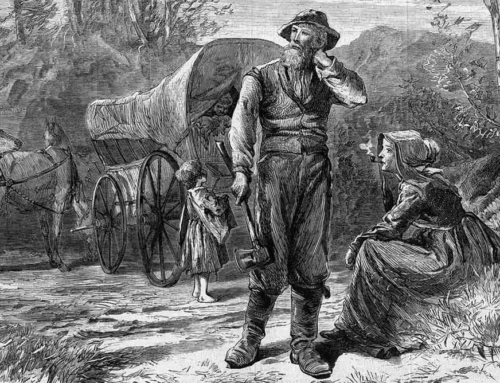
- 1730s/40s: Scots-Irish and German Settlers traveled the Great Wagon Road (Warriors' Path) from Pennsylvania through the Shenandoah Valley of Virginia to what was then Bladen County and built homes.
- 1745: St. John's Lutheran Church was organized.
- 1749/50: Anson County was formed from the western portion of Bladen County.
- 1751: Poplar Tent and Rocky River Presbyterian Churches were organized.
- 1755: Governor Arthur Dobbs visited his lands in that portion of Anson County which became Cabarrus County.
- 1762: Mecklenburg County was formed from Anson County.
- 1771: The Gunpowder Plot, in which nine young men from the Rocky River Section of Cabarrus County blew up the King's gunpowder, which was intended to be used against the Regulators, who were western NC farmers protesting against the policies of English officials.
- 1775: According to many historians, on May 20, the Mecklenburg Declaration of Independence was signed in Charlotte by a countywide delegation, which included eight representatives from the section that would become Cabarrus County. Although there continues to be controversy over the document, the original of which was lost in a fire, the date appears on the NC State Flag by act of the Legislature. In any event, the admittedly genuine Mecklenburg Resolves were enacted on May 30, 1775. Local militiamen participate in early actions against the Cherokee Indians and the Scovellites, who were Tories in South Carolina.
- 1783: Taylor's Meeting House, now Bethel UMC, was organized.
- 1790: Cold Water Baptist Church was organized.
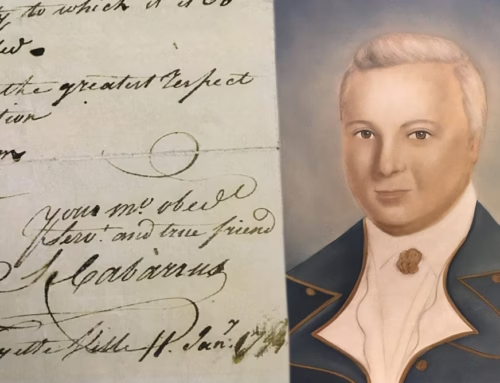
- 1792: After several setbacks, a Bill was ratified on December 29, setting off the northeastern portion of Mecklenburg County, which was to be named Cabarrus, after the popular Speaker of the House of Commons, a French native named Stephen Cabarrus.
- 1793: On January 21, the first meeting of the Cabarrus County Court of Pleas & Quarter Sessions was held, at which the Cabarrus County government was organized.
Concord Beginnings:
- 1793-1795: The County Court met in the home of the widow of Robert Russell, while residents debated the location of the new County's seat of government.
- 1795: After the Legislature threatened to intervene, the dispute was settled. There was an agreement to locate the public buildings for the new County seat on Samuel Huie (Hughey) 's land and to have the tract surveyed.
- 1796: In February, a 26-acre tract was conveyed by Huie to the Commissioners. Lots in a Town to be named Concord ("Harmony") to be surveyed and sold. In April 1796, deeds to the purchasers of the town lots were probated (proven) before the County Court.
- 1798: An Act was passed by the General Assembly to regulate the Town of Concord better.
- 1799: Gold was discovered in Cabarrus County, on the lands of a Hessian soldier, John Reed.
- 1804: A Presbyterian Church was organized in Concord.
- 1806: Concord incorporated by the Legislature.
- 1814: Cabarrus Volunteers left for Alabama to help "Andy" Jackson against the Creek Indians.
- 1825: Lafayette visited North Carolina; men from Concord were part of his military escort.
- 1837: Written records for the Concord City Government begin; earlier records are lost. On March 13, 1837, newly-elected Magistrate of Police (now, Mayor) J. L. Beard, and four Town Commissioners met to take their oaths of office and organize the City government.
- 1838: Concord Methodist Church (Central UMC) was built on what is now Church Street, giving the street its name. The 1838 Tax list shows "taxables" in Concord as 46 white males and 29 African-American males. Poll tax on each male was 50 cents; town property was taxed at 25 cents per $100 valuation and yielded a total tax in 1838 of $111.00.
- 1839: The first cotton factory in Cabarrus County was organized in Concord; it was built in 1841.
- 1841: Beginnings of public schools in North Carolina.
- 1843: Members of Cold Water Lutheran Church decided to build a new church in Concord on East Corban Street, adjoining a cemetery site donated by George Kluttz and a church school. After the new church, St. James Lutheran, moved to its present location on South Union Street, the site continued to be used for educational purposes, serving as the site of Clara Harris School and later as classrooms for Rowan-Cabarrus Community College. It is now the site of the County Jail.
- 1847/48: Cabarrus County Volunteers in the Mexican War. Upon their return in August 1848, a memorable celebration was held in Concord.
- 1850: Concord Steam Cotton Plant employed 50 persons—smallpox epidemic in the area.
- 1852: City Minutes refer to a new "cross street by the jail," which became Depot Street, now Cabarrus Avenue; also, a new street "parallel to Main Street," which became Spring Street.
- 1850: The local newspaper, the Concord Mercury, a successor to the Pilot Newspaper, commented on the local boom in business caused by the coming of the railroad.
- 1855: The North Carolina Railroad opened through Cabarrus County. A passenger stop in Southern Cabarrus County was known as Harris' Depot, later Harrisburg.
- 1855: Concord Male Academy organized; R. W. Allison, President of the Board of Trustees. In 1856, a Boarding school for females opened in 1856 the residence of Rev. D. A. Penick.
- 1857: Miss Maggie Bessent conducted a "subscription school" in a two-room frame building behind Central Methodist Church.
- 1859: Mt. Pleasant (originally Mt. Comfort) incorporated. The Lutherans organized a Male Seminary in Mt. Pleasant.
- 1859: According to traditional accounts, the oldest African-American church in Concord, Zion Hill A. M. E. Zion Church, began as Zion Chapel in 1859. Members of the Zion Hill congregation built Price Temple, now Price Memorial A. M. E. Zion Church, in 1895. Members of Price Memorial founded the First Congregational Church, now the United Church of Christ, in 1902.
- 1861: On April 20, First Cabarrus Militia Companies were entrained for the Civil War from the railway depot in Concord. By the War's end, some 2,000 Cabarrus area men in 9 companies left for the War.
- 1865: On April 18, Confederate President Jefferson Davis, fleeing from Richmond, spent the night at the home of Major Victor Barringer on North Union Street, now the location of the Library.
- 1867: Scotia Seminary was founded by Northern Presbyterian Minister, Rev. Luke Dorland.
- 1868: Sixteen-year-old James W. Cannon came to Concord from Mecklenburg County to begin a career in merchandising.
- 1869: St. James Catholic Church held services on Gold Hill Road; later, it moved to Concord.
- 1873: Cannon & Wadsworth established, with J. W. Cannon and J. W. Wadsworth; P. B. Fetzer bought an interest in 1874, and it became Cannon, Wadsworth, & Co. D. F. Cannon was added in 1877, and it became Cannons, Wadsworth & Fetzer. By 1881, it was Cannons & Fetzer. Became a stock company in 1897.
- 1875: The second Cabarrus County Courthouse, located on the northwest corner of Union and Corban Street, burned; most records were saved.
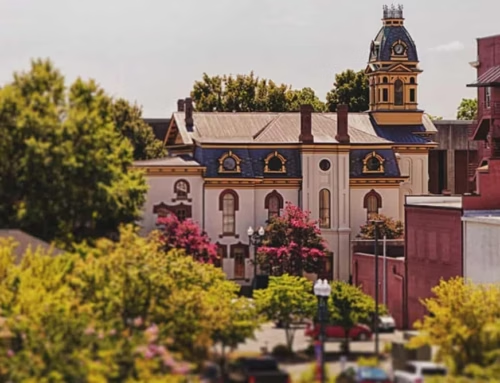
- 1876: The third Courthouse (today's Historic Cabarrus Courthouse) was built on South Union Street.
- 1877: Captain J. M. Odell purchased the McDonald Cotton Mills at a "distress sale." Formed the Odell Manufacturing Company. He enlarged the mill and became very successful. Captain Odell was a staunch Methodist and assisted in building what became Forest Hill Methodist Church near the Mill.
- 1877: Seven Concord families organized an Episcopal Church; they worshiped in the vacant Presbyterian Church building on South Spring Street until 1892.
- 1879: Zion Wesley Institute was organized in Concord; it is now Livingstone College in Salisbury. The positions of Constable and Tax Collector were merged. Appointee served as a combination of constable/tax collector/policeman at a salary of $16.66 per month.
- 1880: A Reformed Church missionary held services in the Courthouse in Concord. The Concord population increased from 700 in 1870 to 1,600 in 1880.
- 1881: A Reformed Church congregation organized; building completed in 1885.
- 1885: Disastrous fire in Concord business district led to a contract in 1886 with P.B. Fetzer to maintain fire hydrants on Union Street. Mr. Fetzer operated the Company until 1901, when the City purchased it for $9,000.00. The water was obtained from A. Franklin Russell's spring on the Coltrane-Webb School Grounds. Later, two artesian wells were dug there. The water was stored in two tanks: one of 30,000 gallons for fire use and one of about 25,000 gallons for "domestic" use. There were eight double-plug hydrants on Union Street. Initially, the water and sewer customers were: Mr. D. F. Cannon; J. W. Cannon; P. B. Fetzer; G. M. Lore; and the St. Cloud and St. James Hotels. A 1893 newspaper article indicates there were then 65 customers, with a minimum monthly charge of $6.00.
- 1886: Baptist services were held in the Courthouse in Concord. Led to the erection of the First Baptist church building at Spring and Grove Streets in January 1889.
- 1887: Concord Hose and Reel Company formally organized; 27 members.
- 1887: J. W. Cannon organized his first cotton mill on Mill Street (later Franklin Avenue), with J. W. Odell as President; a Methodist congregation, first known as Bays' Chapel, grew up to serve the community. It later became Epworth UMC.
- 1888: Concord National Bank opened under the management of Daniel Branson Coltrane.
- 1889: Baptist services held in the Courthouse; first services in the new building held in 1889.
- 1889: Concord Electric Light Company was founded by J. M. Odell. Concord Perpetual Savings & Loan was organized, with John P. Allison as President.
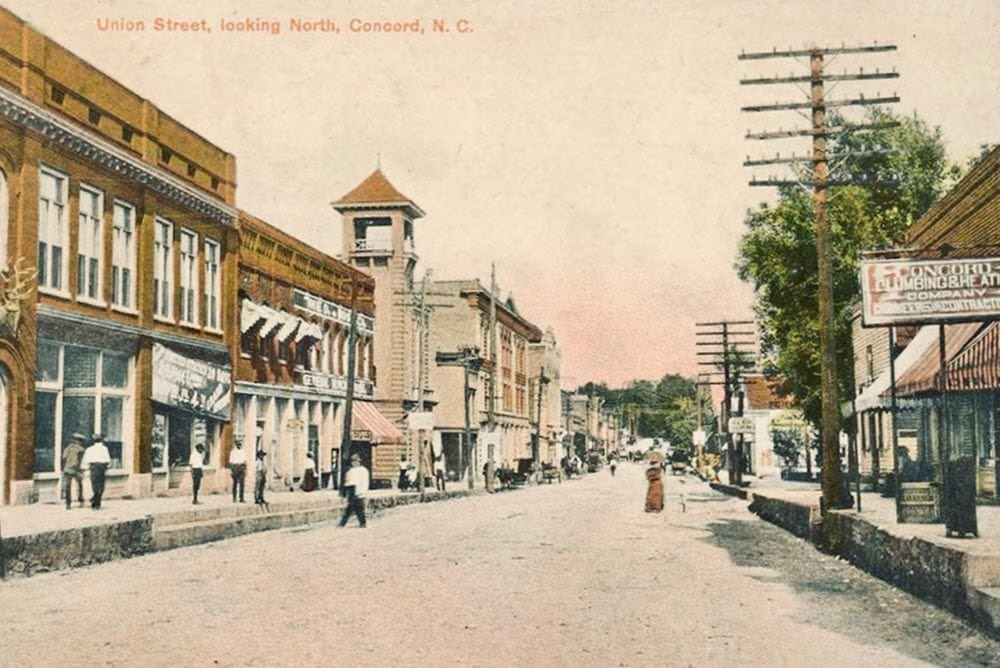
- 1890: Growth boom in Concord; population had doubled to 4,000. A steam railway (the "dummy line"), organized in 1889, ran uptown from the depot. The new St. Cloud Hotel and the Morris House both welcomed guests. The steam railway broke down in the summer of 1892 and did not run again. Kerr Bleaching & Finishing Works incorporated; "bleachers, finishers, dyers, and nappers." W. R. Odell, President.
- 1892: Local contractor A. H. Propst built a lovely Episcopal Church on West Depot Street.
- 1892: J. M. Odell had added three mills to his original plant, bringing the total to 21,000 spindles and 846 looms. Forest Hill, a town of 800 people, grew up around his mills. The Bleachery could treat 40,000 yards of cloth a day. Kerr Bag Manufacturing Company shipped large numbers of bags nationwide. J. W. Cannon built his second plant near the Railroad on Corban Avenue.
- 1892: No formal celebration of the County's Centennial; however, a large group celebrated the dedication of the Veterans' Monument in front of the Historic Courthouse. It was the center of Confederate Memorial Day celebrations until 1965.
- 1893: The City purchased Oakwood Cemetery from Captain J. M. Odell.
- 1895: First telephones in Concord; first customer, Captain Odell's office, connected to the bank.
- 1896: Concord Hook and Ladder Company organized, with 20 African-American volunteers.
- 1897: Concord Telephone Company was founded by L. D. Coltrane, Sr., and investors. Cabarrus Savings Bank opened on January 21, 1897.
- 1898: Cabarrus County Volunteers left on May 2 for the Spanish-American War; returned to Concord on April 22, 1899. Cabarrus County Building, Loan and Savings Association held its first meeting on March 30, 1898. D.B. Coltrane and J.M. Odell on Board.
- 1898: The cornerstone for Coleman Mill was laid with full Masonic honors.
- 1900: Concord population swelled to 8,000 persons. A City Fire Department was organized, replacing the all-volunteer Hose and Reel Company.
- 1901: NC Legislature allowed Concord Town Commissioners to submit a bond issue of $150,000 to local voters, for purposes of (1) payment of all debts of the City, except Bonds previously issued; (2) purchase for $9,000 present water system; (3) improving present system of waterworks and a sewerage system; (4) if any balance, sidewalks. (5) first $25,000 to the Graded School Board for school purposes. The 1851 Town Charter was amended to create a four-member Board of Water Commissioners, with the Mayor serving as an ex officio member who would vote in the event of a tie.
- 1901: Concord voters authorized bonds, which allowed construction of Central Graded School on the site of the old Female Academy, and building a new school on Ann Street.
- 1903: The NC Legislature authorized a Concord election to vote on the issue of lighting the streets and public buildings of Concord. Citizens were to vote on "Lights" or "Darkness." The proposition carried easily. Aldermen approved the contract, and work began in September 1903 on a new electric light plant.
- 1903: New Town Hall built in Concord on South Union Street, with the fire department next door.
- 1905: NC Legislature authorized formation of Board of Light and Water Commissioners, with three members and the Mayor as ex officio member.
- 1905: Brown Manufacturing Co. was incorporated on April 12, 1905.
- 1906: J. W. Cannon begins construction of a "model mill town" on a site in northern Cabarrus County. There is early confusion about the name of the new village. A Concord Times story on July 10, 1906, refers to the town as "Cannapolis." A story in the Carolina Watchman (published in Salisbury) discusses the correct spelling: "It is a combination of two words, Cannon and Polis, the latter meaning a city. The final N in Cannon is dropped, thus making the correct spelling Cannopolis." November 20: The first loan of lumber (1,200 feet of green lumber) was hauled into Kannapolis by "Trim" and another mule.
- 1906: Citizens Building & Loan Ass’n organized; office in Citizens Bank & Trust.
- 1907: June 3 – J. W. Cannon asked the County Commissioners to improve and pave the road from Concord to Kannapolis. It is now Main Street/ US 29A.
- 1908: Aldermen approved a contract for a street railway, and tracks were laid. The inaugural run of the battery-operated streetcar took place in the fall of 1911. Replaced in 1912 by a traditional trolley car, which operated until 1925. On October 5, 1942, the Alderman ordered the tracks removed and used in the war effort.
- 1909: Jackson Training School opened in Cabarrus County. Concord citizens and the newspaper editor were instrumental in its formation.
- 1911: The Library was organized under the leadership of Mrs. L. D. Coltrane and many others. The Foard House, a hotel on South Union, was demolished to make way for a modern Post Office to be erected to the south of St. James Lutheran Church.
- 1918: Hoover Hosiery Company incorporated by A. R. Hoover, W.W. Flowe & S. D. Arrowood.
- 1921: J. W. Cannon died. His son, Charles A. Cannon, succeeded him as head of the Cannon textile interests.
- 1926/27: Lake Concord was built, followed by Lake Fisher in 1946.
- 1927: Hotel Concord was built on the site of the former St. Cloud Hotel.
- 1927: J. W. Pike, Sr., brought his family to Concord and bought Pearl Drug Company; the beginnings of the Pike Drug chain. Edward K. Willis started Willis Hosiery with 40 employees, making women's cotton-rayon hosiery. J. Roy Davis, Sr., and Lawrence Switzer founded S & D Coffee in Charlotte, then moved to Concord in 1928.
- 1928: C. A. Cannon organized nine mills of the Cannon Group into Cannon Mills Company.
- 1937: July 26 – First surgical procedure and first patient admitted to Cabarrus Memorial Hospital—surgery by Paul K. Maulden, M.D.
- 1937: Celebration of Concord "Bicentennial"; new Armory dedicated
- 1941: December 7 – the Japanese attacked Pearl Harbor.
- 1949: Celebration of Gold Sesquicentennial Boys' Club opened on Spring Street with 700 members.
- 1953: Concord has a population of 16,720; Cabarrus County: 63,910.
- 1957: A new City Hall was built.
- 1959: Charlotte Motor Speedway was organized by Bruton Smith and Curtis Turner. The first race, World 600, was held in June 1960. After the 1961 World 600, the Speedway entered Chapter 11 bankruptcy; Smith and Turner lost control. In 1963, the Speedway emerged from bankruptcy, and a group of investors led by Richard Howard assumed control. In 1975, Bruton Smith had acquired enough stock to resume ownership. He hired H. A. "Humpy" Wheeler as president and general manager.
- 1960s: Integration of Concord Schools.
- 1971: April 2 – Charles A. Cannon died. It was the end of an era as the leadership of Cannon Mills passed outside the Cannon Family.
- 1972: Allison Building demolished after 114 years; site of new Courthouse.
- 1973: Carolina Mall opened.
- 1975: New Courthouse dedicated – historic 1876 courthouse preserved through the action of local citizens. Professor Albert Coates, founder of the Institute (now School) of Government, was the featured Speaker at the dedication.
- 1978: Phillip Morris announced its intention to build a plant in Cabarrus County. The site of its plant was later annexed into the City of Concord.
- 1980: Census put Concord's population at 17,835.
- 1981: Concord annexed 278 acres along US 29-601.
- 1982: Concord announced plans to annex 8.06 square miles to the south and West of the City; the area included the Phillip Morris plant.
- 1982: After the City Board of Aldermen voted to annex the 8.06-mile area, four lawsuits were filed to contest the annexation.
- 1983: Governor Jim Hunt offered his assistance to Concord and to Phillip Morris to resolve the annexation dispute. A settlement was reached on March 21, 1983, and an agreement setting the annexation date to June 30, 1986, was signed.
- 1984: Concord approved a $20 million bond issue to pay for water and sewer in the annexed areas, and to build two fire stations.
- 1985: Concord population about 18,000.
- 1986: Concord's area increased to 19.57 square miles and 26,000+ in population. The area included three schools (Wolf Meadow Elementary, Winecoff Elementary, and Hartsell Middle); four sanitary districts (Jackson Park, Rockland, South Concord, and Parkwood, and parts of four volunteer fire department districts (Jackson Park, Allen, Winecoff, and Poplar Tent).
- 1989: Hurricane Hugo damaged Cabarrus County with sustained winds of 70 mph and gusts of about 90 mph.
- 1990: Outgoing Cabarrus County Commissioners transferred a regional airport to the City of Concord, to avoid its being canceled by the incoming Board of Commissioners. The action was contested in court, but was upheld.
- 1991: Work began on the Coddle Creek Reservoir and a Water Treatment Plant.
- 1991 Concord annexed 3.66 square miles.
- 1994: September – The first airplanes take off and land at Concord Regional Airport, just West of 1-85 in western Cabarrus County.
- 1995: At midnight on December 31, Concord annexed nearly 14 square miles into the City, gaining some 6,200 residents.
- 1995: Reservoir completed on Coddle Creek, in partnership with the County and Kannapolis.
- 1996: S & D Coffee broke ground on $10 million expansion, adding 102,000 square feet.
- 1990s: In a contested election, liquor by the drink comes to Concord.
- 1999: September 16 – Grand opening of Concord Mills Mall.
- 2000 Concord population 55,977 per census.
- 2003: Textile mills close.
- 2004: November 11 – Celebration of the 10th Anniversary of Concord Regional Airport. Concord recognized with All-America City Award
- 2006: October 9 – Opening Ceremony and Open House, Concord Police Headquarters
- 2007: January 19 – Grand Opening, Embassy Suites Charlotte-Concord Golf Resort & Spa, and Concord Convention Center
- 2007: May 1 – Groundbreaking Ceremony for the Windshear Wind Tunnel
- 2008: December 17 – Dedication of Fire Station #9, Concord Police Substation, City Biodiesel Fueling Station & Community Room, 1020 Ivey Cline Road.
- 2009: June 29 – Grand Opening, McEachern Greenway Downtown Connector.
- 2010: Concord population 79,066; twelfth largest City in North Carolina.
- 2015: Gary Gacek of Milwaukee was named the new Police Chief for Concord
- 2015: Concord celebrates 50 years of Council-Manager form of government
- 2015: The New City Hall building on East Cabarrus Avenue opened in December; Council members Dave Phillips and Jim Ramseur retired after 20 years.
- 2016: Concord population estimated at 89,891 to pass Asheville for the 11th largest municipality in the state with an annual growth rate of 13%+.
- 2016: City received coveted Certificate of Achievement for Excellence in Financial Reporting in 2016, 28th consecutive year.
- 2017: Mayor Scott Padgett declines to run again after 16 years as Mayor; appointed to the Local Government Commission by Governor Roy Cooper. In 2018, the Regional Airport was renamed in his honor. (Concord-Padgett Regional Airport)
- 2017: City hired Dirk Vanderleest as Aviation Director at the Regional Airport.
- 2017: Money Magazine ranked Concord as number 38 on its list of Top 100 Places To Live between 10,000 and 100,000 people in population.
- 2017: Haines announced it would open a 500,000 sq. ft. distribution center in 2018 in the Airport Business Park.
- 2017: Bill Dusch elected Mayor with about 40% of the vote. Terry Crawford upset 30+ Year veteran City Councilman Lamar Barrier.
- 2017: Announced work on new parking deck to begin; to provide additional parking space for the County Courthouse and Addition.
- 2017 Money Magazine named Concord "Best Place to Live" in North Carolina.
- 2018: Seven-day-a-week express bus service from Concord to Charlotte began.
- 2018: February 1, designated Warren Coleman Day in Concord
- 2018: City Manager Brian Hiatt retired; Asst. Mgr. Lloyd Payne was named to succeed him. Payne named LeDerick Blackburn and Joshua Smith as Assistant City Managers. Blackburn was the first African-American Assistant City Manager for Concord.