Old Courthouse Theatre’s History From 1976 To 2010
Written by Anne Wilson for the Historic Cabarrus Association (2011)
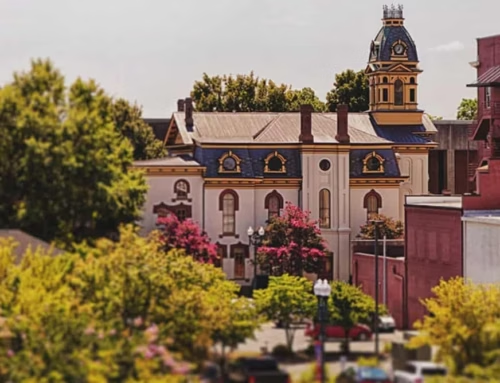
The Historic Cabarrus County Courthouse, built in 1876, was targeted for demolition in 1973 as construction of a new Cabarrus County Courthouse was underway. At various stages, plans were to convert the site into an office building or a parking lot, and the Historic Courthouse was to be torn down to make way for progress. Historic Cabarrus, Inc., a group formed to preserve Cabarrus County's history, went before the County Commissioners to request a reprieve to save the building. The Commissioners granted Historic Cabarrus six months to present bids for restoration and to determine a use for the historic building.
Consistent with most successful ventures, the Old Courthouse Theatre began as one person's dream. On May 5, 1976, without much fanfare, Third Century Artist Mary Snead Boger held a meeting at the Hotel Concord for those interested in forming a community theater in Cabarrus County. There had been a community-theater group, the Concord Little Theatre, in Concord during the early '50s, but it was no longer active. Mrs. Boger placed 25 chairs in the hotel ballroom and hoped there would be enough interest to fill them. Before the evening ended, more than 70 people attended and contributed five dollars each to become charter members of this then-unnamed dream. Mrs. Boger, looking for theater space, joined with Historic Cabarrus, Inc., in a successful effort to save the "old courthouse" and was granted use of the second-floor courtroom, now the Davis Theater, for the Theater. The Old Courthouse Theatre (OCT) was born.
For its first production, Mrs. Boger wrote, auditioned, cast, and directed a variety show that was performed in June 1976. Mrs. Boger chose this two-day play to quickly introduce Cabarrus County to the potential of the Theater and of the "Old Courthouse," to show that the group was legitimate, and to demonstrate that a variety of local talent could be used in these productions. On June 25 and 26, 1976, OCT presented "Cabarrus Chautauqua" to sold-out audiences, featuring 12 acts representing real stars who may have performed in and around the area during the 1890s to 1910s. Now with almost 200 charter members, the Old Courthouse Theatre had become a reality. Mrs. Boger's point was proven. Cabarrus County was ready and eager for live Theater.
Many people helped in the efforts to save the "Old Courthouse," but two stand out: Mary Snead Boger, with her efforts to bring cultural arts to Cabarrus County and provide a use for the old building by the formation and leadership of Old Courthouse Theatre, and Robert Burrage, Sr., who began a fundraising drive for Historic Cabarrus and appeared before the County Commissioners to convince them that the historic structure should be saved. Mr. Burrage appealed to everyone, from schoolchildren to businesses, for donations ranging from dimes to thousands of dollars, or for labor and paint. Many others who could not donate money gave freely of their time to paint, clean, cut back the ivy that had spread almost through the windows on the second floor, or to humanely catch and remove the pigeons from the old clock tower. By the time OCT's first-season production was presented in November, a fresh coat of paint covered the old building, inside and out. OCT, along with Historic Cabarrus, was credited by many as sparking the drive that saved the 1876 Courthouse from the wrecker's ball.
That first season, the people of Cabarrus County saw a serious drama, "The Lark"; a comedy, "Finishing Touches"; and a musical, "Brigadoon." All played to sold-out audiences. OCT's goals were (and continue to be) to present quality theater and to provide opportunities for the citizens of Cabarrus County and the surrounding area to participate in the experience of a live theater production, whether on stage, backstage, or in the audience. As Mary Snead Boger told the local press after the first season: "Theater is possibly the most encompassing of all art forms. It satisfies the creative talents not only of those who want to act, sing, or dance, but also of visual artists, makeup artists, set designers, businesspeople, ticket salespeople, promoters, lighting designers, costumers, and seamstresses. OCT is for everyone in the county who needs self-expression, and it needs an appreciative, supportive audience. Its goal is to establish in Cabarrus County quality drama performed professionally by local and area amateur actors."
Over the next five seasons, OCT became a driving force in broadening our community's and the surrounding counties' cultural awareness. During the fifth season, Mrs. Boger entered the North Carolina Theater Conference one-act play competition with the play "The Lover." "The Lover" was probably one of the most sophisticated pieces of Theater ever presented in Cabarrus County. Actors John Nordan, Linda Pierce, and Richard Moore impressed the judges and walked away with the Best Play, Best Actor, and Best Actress Awards. This accomplishment by OCT helped secure additional grant funding to continue the restoration effort. Local and state dignitaries attended a performance after the award-winning group returned home; among them was Sarah Hodgins, secretary of Cultural Resources of North Carolina, who presented OCT with a $12,000 restoration grant to help upgrade the Theater.
OCT was riding on the crest of a state award-winning play and a successful season when the ceiling fell in—literally. During a dress rehearsal for the last play of the fifth season, "Sweet Charity," chunks of plaster dropped from the theater ceiling just above the stage. No one was injured, but finishing the set's details was delayed. The play was to open in four days. The construction company made temporary repairs, and the play went on as scheduled. Historic Cabarrus, Inc., the lessee of the building, discovered during those repairs that extensive work was necessary to the roof and the ceiling. OCT was forced to vacate the building, and the entire upstairs area was demolished. Historic Cabarrus, Inc. organized a fundraising campaign to "repair the roof and fix the theater area." Members of Historic Cabarrus, Inc. and Old Courthouse Theatre, Inc. appeared before the County Commissioners to request an allocation of $60,000 for emergency repairs. A one-time-only request, it was estimated that repairs would cost $120,000. The Cannon Foundation had agreed to donate $40,000, provided the other $80,000 could be raised by September. The County Commissioners voted them down 3–2. The reasoning was that Historic Cabarrus, Inc. had signed a five-year lease agreement that mandated the county "shall have no obligations or duties concerning the maintenance, preservation, or upkeep of the premises…" and no tax money was to be used. Supporters of Historic Cabarrus, Inc. and Old Courthouse Theater, Inc. reminded the commissioners of the volunteer hours and the over $200,000 raised in the restoration effort of the county-owned building. Not one cent was tax money. A similar request was made to the Concord Aldermen, who initially declined but then voted to give Historic Cabarrus $3,000. This money was a portion of the proceeds from the sale of an old fire truck, not tax money.
News of the Old Courthouse's plight reached NC Governor Jim Hunt. Gov. Hunt and Eighth District Congressman Bill Hefner indicated they would help secure funds for the restoration project. Rep. Dwight Quinn sponsored a special appropriations bill for $50,000. In the meantime, Historic Cabarrus, Inc. and Old Courthouse Theater, Inc. stepped up their fundraising efforts. Ultimately, monies were raised from grants and donations from businesses and individuals. Restoration work could continue, and OCT would be back at "home" soon.
The gypsy years began for the Old Courthouse Theatre. OCT presented four seasons, 14 plays, at the Winecoff School, Concord High School, and Concord Middle School auditoriums, storing props, costumes, set pieces, lighting instruments, and all the "stuff" needed for productions in basements, attics, sheds, truck trailers, and homes. Rehearsals were held where space could be found. The school auditoriums were often hard to find for newcomers and had to be rented for rehearsals and performances. Props, costumes, and set pieces had to be put away each night because classes used the stage and "dressing rooms" as schoolrooms during the day. Maintaining the uniqueness of OCT outside its physical home proved difficult. It was hard being dispossessed, carting "stuff" back and forth. Everyone worked hard to maintain high artistic quality, but along the way, patrons, props, costumes, and patience were lost. The cost of renting the school auditoriums and storage space had become almost prohibitive, adding at least $2,000 to each play budget. With each production, the hope remained that OCT would soon return home to a beautiful new theater at the Historic Courthouse. Plans were made to return for the 1983–1984 season. OCT had been asked to raise $100,000 to be used exclusively toward the theater area proper at the Historic Courthouse. It did so, and the funds were placed in escrow for use only for theater purposes. These monies were not used in any restoration of the Historic Courthouse.
In the fall of 1983, the new roof and clock tower were finished, but the second floor was still gutted. At that time, OCT was informed that the Theater should raise $300,000 for the theater area, as funds for further renovation were unavailable. OCT was also told it must do this without being granted a long-term lease for the theater space. OCT also had no control over the use of the space or the storage and had to pay a minimum of $500 per month in rent. OCT had approached several foundations that were seriously interested in funding the Theater, but would not consider any arrangement that did not include at least a 25-year lease and control of the leased area. With reluctance, OCT realized the necessity of giving up the dream of moving into the Historic Courthouse and of looking for a new home.
In December 1983, it was announced that OCT had bought the old Belk building (currently known as Union Street Square, home to a variety of businesses) in downtown Concord. Its 50,000 square feet would provide office, rehearsal, storage, and scene shop space. The ninth season would be performed in the school auditoriums, but rehearsals could be held in the old Belk building. OCT hired an architectural firm to research and draw up plans for the new Theater. It was estimated that the Belk building could be turned into a splendid facility, but due to stringent building codes, the cost would be $2.5 million, an amount well beyond OCT's means. Once again, it seemed that OCT would be homeless.
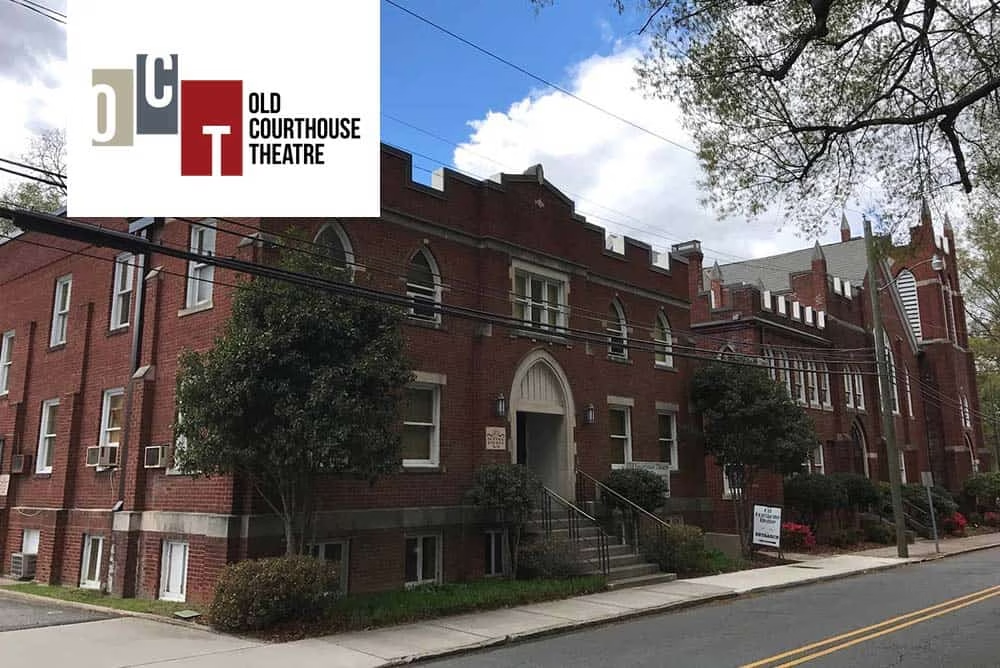
In April 1984, OCT petitioned for rezoning of the First Baptist Church property on Spring Street NW. First Baptist was moving to new facilities on Branchview Drive. OCT requested the option to purchase the building. The church building would provide OCT with all the space needed for an auditorium, stage, dressing area, storage, and office space, with minimal renovation. The Belk building would be sold. The Concord Planning and Zoning Board approved the request. The Historic District Commission approved. In October 1984, First Baptist agreed to sell the building on Spring Street to OCT.
By the beginning of its tenth season, OCT finally had a home. In September, almost everything was moved from all the storage spaces and into the old First Baptist building. The first production, "The Glass Menagerie," opened in November 1985. A temporary stage was built, and cushions were added to the old church pews. A capital fundraising campaign to renovate the building had begun.
The excellent reputation of the quality theater productions and the tenacity of Mary Snead Boger helped to secure the rights for the musical "Evita" and the British farce "Noises Off" before any other amateur theater in the US. In November 1986, OCT received the NCTC state award "For Leadership in Theater Arts in North Carolina": "The fine acting, totality of professionalism, and warm giving spirit of OCT has proved a stimulation to, and an inspiration for theater all over North Carolina." Over six years, OCT had entered the NCTC one-act play competition and had won awards for Best Play, Best Actress, runner-up for Best Play, and three times for Best Actor.
In August 1987, Mrs. Boger announced she would resign as artistic director at the end of the season. It came as a surprise, but she said it was time to do something else. Her dream had become an award-winning Community Theater, well respected throughout the state and region. The loss of Mrs. Boger would be felt by actors and patrons alike. The OCT Board of Directors formed a committee, and the search for her successor commenced. They not only had to find a new Artistic Director but also a new Business Manager, as long-time Business Manager Betsy Gebhardt was also retiring. Applications came from all over the world.
The search committee completed its task in the spring of 1988. A nationally known director and playwright from Washington state, Michael Brill, was named as Artistic Director. Anne Wilson, an OCT volunteer, Board Member, and Guild Chair from Concord, NC, was named the new Business Manager. During Mr. Brill's short time with OCT, the community saw an innovative version of "The Brief and Comic History of Tom Jones," "Vanities," and another state award-winning play, "Lemonade." Mr. Brill had come from a very metropolitan area, and small-town life was not to his liking. He wasn't happy and had difficulty with an all-volunteer base.
Once again, a search was conducted. The remainder of the season was guest-directed. By the end of the season, a new Artistic Director was named. Louisiana native Dawson Corley began the 1989–1990 season with the American classic "Look Homeward, Angel." The cast and crew traveled to Asheville to visit the Thomas Wolfe Memorial. The trip was extraordinary because, as the cast and crew were researching their roles, they were followed by a production crew from CBS-TV's Sunday Morning with Charles Kuralt. The production crew also came to Concord to film a performance to be featured in September.
August 1989 was a busy month for OCT. John Warburton, a visitor from Great Britain who had been traveling for the Winston Churchill Memorial Trust, paid a visit to OCT. He had been touring the country, visiting theaters, primarily community theaters, and had heard of OCT. He spent several days at OCT learning all aspects of the Theater and its history. OCT was presented with a commemorative Winston Churchill Memorial Trust medal at the end of his visit.
During his time with OCT, Mr. Corley started the Old Courthouse Youth Theatre with the production of "The Best Christmas Pageant Ever." He also directed Noel Coward's witty comedy "Blithe Spirit" and the Sondheim musical "A Little Night Music." By February 1990, OCT had lost another Artistic Director: Mr. Corley, and OCT dissolved its contract through mutual agreement. The search continued. The following two productions were guest-directed. "Steel Magnolias," the last play of the season, was directed by Michael Ricci, who had guest-directed the previous season. The Board offered Mr. Ricci, a New York native, a three-year contract, and he became the third Artistic Director in two seasons. Mr. Ricci continued the American classics and the Youth Theatre. The Youth Theatre's Shakespearean adaptations were especially popular. Mr. Ricci started the Off-Broadway series and acting workshops. For part of the 1992–1993 season, Anne Wilson had to take a short leave of absence for health reasons. During that time, the office was run by several volunteers and part-time paid staff. Mrs. Wilson returned as the volunteer Business Manager to help with the money crunch. OCT continued for the three years of Mr. Ricci's contract. But the problems with maintaining the old church building were eating into the budget faster than plays could be performed and the funding replenished. To help with funding, the OCT Guild started the Annual New Year's Eve Murder Mystery Dinner Theater. But at the end of Mr. Ricci's third year, OCT had to release him from his contract because it was becoming increasingly complex to pay him and support the building and productions.
At that time, the Board decided to continue with guest directors until it could hire a full-time director. From 1994 to 1997, all productions were guest-directed. During this time, OCT received national exposure for a second time when "The Sound of Music" was performed with Daniel Truhitte in the role of Captain von Trapp. Mr. Truhitte had appeared in the movie version as Rolf. OCT won Best Play for the third time at the North Carolina Theater Conference for "A Novel Romance." The guest directors did outstanding work on very tight budgets. Still, something was missing: continuity.
A concerted effort was made to reach out to the business and corporate community to assist with funding the productions by instituting the Producing Partner Program. In this way, a business, corporation, or community organization could pay up to half of a play's budget and, in return, get publicity for their business or organization, a pre-show reception, and a performance for their guests. Organizations as diverse as the Arc of Cabarrus County, the Coltrane Life Center for Senior Adults, the Cabarrus Senior Center, CVAN, and scout groups sold tickets to their performances as fundraisers. OCT plans to continue the Producing Partnership program in future seasons. It is a mutually beneficial program for everyone involved.
At the end of the 1996–1997 season, the Board once again decided the time was right to hire a full-time Artistic Director. This time, they chose Heather Wilson, a hometown girl who had recently graduated from Catawba College in Salisbury with a degree in Theater Arts. Ms. Wilson had guest-directed two one-act plays on the main stage for OCT after college. She was also very familiar with OCT, its crews, actors, and patrons. Heather had appeared in OCT productions under the direction of Mary Snead Boger, worked backstage, appeared as Agnes in "Agnes of God," and, most recently, appeared in the OCT award-winning play "A Novel Romance." At the beginning of the 1997–1998 season, Ms. Wilson became OCT's fifth Artistic Director.
For the next ten seasons, Ms. Wilson brought her creativity, eye for detail, a passion for quality, enthusiasm, and the ability to work with actors and crew of all ages. Having been an actress, she knew what it was like to be on the other side of the footlights. She was also an excellent representative for the Theater. Growing up in Concord gave her knowledge of the surrounding communities. The actor and crew base grew, as did the season-ticket subscribers. She gave her best to OCT and her community and expected no less from the casts and crews of the productions. She wanted to continue the dream started by Mary Snead Boger in 1976 and to allow the citizens of Cabarrus County and the surrounding area to participate in the magic of live Theater, whether as performers or audience members. She directed a variety of plays, not only the "safe choices" but also plays that make the audience think and challenge the actors and director to do their best. Ms. Wilson announced plans to leave at the end of the 2006–2007 season to pursue a Master's in Fine Arts in Directing at the University of Memphis. Her last play of the season, "Grace & Glorie," was nominated and won Outstanding Lead Actress, Outstanding Set Design, Outstanding Sound Design, and Outstanding Special Effects at the Metrolina Theater Association Annual Awards Gala. On May 8, 2010, Heather Wilson graduated Summa Cum Laude from the University of Memphis with a Master's in Fine Arts–Directing.
OCT continues to make repairs and improvements to its building. Through grants from the Cannon Foundation, window frames have been painted, a new AC system installed in the main building, the heating system in the Black Box upgraded, and roof repairs completed. The two large stained-glass windows have been restored to their former glory thanks to donations and grants.
J. Carlyle Rutledge and the Salisbury Foundation, along with individual donations, funded the new bathrooms, offices, and a new AC/Heating system for those areas in the main building. As of this writing (2011), OCT recently received a grant to install a new ramp for better accessibility for people with disabilities and to begin repaving the parking lot. Work continues on plans to repair the restrooms in the Black Box Theatre, renovate the Black Box Theatre, and improve accessibility for people with disabilities.
For now, OCT is again using guest directors for the productions, continuing to provide our audiences with quality performances and bringing new people and ideas to the theater experience. OCT has been nominated and won at the Metrolina Theater Association Awards Gala for several productions, including a special production of "Benedictions." OCT has taken home Outstanding Lead Actor & Actress, Outstanding Production, Outstanding Director, Outstanding Supporting Actress, and Outstanding Costume Design & Outstanding Sound Design awards for other productions.
Old Courthouse Theatre was founded as a community theater to furnish entertainment for community audiences, serve as an outlet for performing-arts talent, and enrich community life. With the regular-season productions in place, OCT began looking at other ways to serve the citizens of Cabarrus County. The season offerings have primarily included family-friendly plays, as well as more adult fare to suit our audiences' tastes. Many Youth and Children's Theatre productions have been provided as part of a season or as an extra production. OCT has had theater classes for youth and children. The Black Box Theatre is a space used for Youth and Children's Theatre productions. It will also be a space to present off-season productions of more challenging content to Cabarrus County. Recently, OCT's Black Box Theater has served as the performance space for the newly created "Living Room Reader's Series," with OCT veteran Jonathan Ewart as coordinator for a five-play season. These free staged reading performances feature plays that may be entertaining, interesting, or thought-provoking, performed by seasoned actors as well as those who may never have set foot on the stage.
Another recent addition to the OCT family is Cabarrus County Pretenders. OCT charter member, actress, and retired schoolteacher Becky Porter founded Cabarrus County Pretenders—CabCo for short —fulfilling a lifelong dream. CabCo is a dedicated group of adult actors performing stories and plays suitable for a younger audience. This group will travel throughout Cabarrus County, visiting schools, libraries, daycares, and preschools, and performing on the OCT stage. Most recently, CabCo was invited to perform in Jacksonville, NC, for a fundraising event for the new Children's Museum there.
OCT hosts in-house American Sign Language classes through HandPrints Ministry, ensuring interpreters are available for all OCT performances. OCT offers space for nonprofit and other civic organizations to hold meetings. The Producing Partners Program continues to support nonprofit organizations by providing tickets for a performance to be sold as a fundraiser for the group. Free final dress performances are offered to local day care centers, the Church of God Children's Home, CVAN, assisted-living facilities, and group homes. OCT regularly donates season tickets and individual performance tickets to schools, churches, nonprofits, and civic organizations to assist with their fundraising efforts.
OCT has become more involved with the community by joining the Cabarrus County Library System's "One Book–One Community" program, presenting plays, staged readings, solo performances, and music that accompany the selected books. In early 2011, a committee, led by Heather Wilson and including representatives from OCT and Historic Cabarrus Association, Inc., gathered oral histories from area veterans of WWII, Korea, and Vietnam for a multimedia performance piece, "Paying Tribute," which was performed on the OCT stage in March 2011. Ms. Wilson was the playwright and artistic director for this performance piece. After 35 years, the Old Courthouse Theatre and Historic Cabarrus Association once again joined forces to give something to the citizens of Cabarrus County!
Old Courthouse Theatre, Inc. has come a long way from the Historic Courthouse courtroom. Sometimes the way has not been easy, but that in itself makes those who have been here appreciate the accomplishments even more. Passion, dedication, and pure stubbornness have kept the dream alive.
OCT is still staffed and run by volunteers. All actors and crew are volunteers with "real" jobs and families. OCT is still supported primarily by season ticket sales, Producing Partners or Sponsors, and individual ticket sales. OCT receives a Grassroots Grant from the North Carolina Arts Council, administered by the Cabarrus Arts Council, which accounts for about 3% of its budget. OCT receives no direct city or county funding. OCT gives tickets to Cabarrus County nonprofit organizations for their fundraising. Plays cost from $6,000 for a comedy or drama to $15,000+ for a musical, depending on the elaborateness of costumes and set and the royalty rights. The building still needs repairs and maintenance. Donations of time, supplies, and money are always needed and welcomed.
Will OCT ever change its name? No. Old Courthouse Theatre has never changed its name because we want people to remember where we began, and we are proud of our beginnings. The name is well recognized and respected in the region. Everyone is welcome as long as they are willing to give their best to ensure that all productions meet the quality standard that has long been a part of Old Courthouse Theatre productions.
Anne Wilson remains extremely active as an OCT volunteer and was nominated for the 2010 Metrolina Theatre Association "Theater Person of the Year" award. She and her husband, Trent, are sustaining members of the Historic Cabarrus Association.