Concord: A Bicentennial Sketch – 1796-1996
Written by Clarence E. Horton Jr.
Although the Cabarrus County government was formally organized by the newly formed Court of Pleas and Quarter Sessions at its first meeting on January 21, 1793, and the first county officials were elected, the dispute over the seat of government's location continued until 1795, when a site was agreed upon. A town to be named "Concord" was laid out on a 26-acre tract of land lying on the ridge near the old Indian Trading Path and to the west of Three Mile Branch. By traditional accounts, the name was chosen to represent the "harmony" or Concord between the opposing factions in the site location dispute.
By the April 1796 Session of the County Court, the land had been purchased, surveyed into lots, and sold at public auction to the first Concord landowners. Many of them bought lots for investment, while maintaining their principal residences outside the town site. By the 1800 Census, the new town had a population of 33, including four enslaved persons. Before its formal incorporation in 1806, it was managed by the County Court of Pleas and Quarter Sessions. Often referred to as the "county court," the Court of Pleas and Quarter Sessions was composed of the duly-appointed Justices of the Peace for the County, who exercised both judicial and administrative functions. In a sense, the county court fulfilled many of the combined duties of today's County Commissioners, Clerk of Superior Court, and lower courts. Among other things, it set tax rates, supervised road maintenance, probated wills and deeds, and elected most local officials.
Concord was incorporated in 1806, but the earliest official records of city government have been lost. Records of the 1821 city elections are preserved in area newspapers. The City's written records begin with the Minutes of a meeting on March 13, 1837, when newly elected Magistrate of Police (now Mayor) J. L. Beard and four Town Commissioners met to take their oaths of office and to organize city government. By 1838, the tax list listed "taxables" in Concord as 46 white males and 29 African American males. The poll (head) tax on each male was 50 cents; town property was taxed at 25 cents per $100 valuation. Those valuations yielded a total tax of $111.00 for the year.
From the end of the Revolutionary Period to the end of the Civil War, counties in North Carolina exercised judicial and administrative functions through their local County Courts. At the same time, towns were generally small trading centers and seats of local government until 1865. Wilmington, the most populous City in the State, was the only municipality with more than 5,000 people. The towns had few government functions. Thus, our records show that the early Concord officials wrestled with questions of imposing and collecting taxes, preserving the public health and safety through local ordinances, and opening and maintaining the public streets. In addition to providing for the collection of taxes by the town constable, the Board appointed responsible citizens to repair the firefighting equipment and the public roads. Early ordinances penalized persons for running their horses through the streets of Concord and for firing a gun within the City. Other safety ordinances imposed fines on persons allowing cattle to lie in the city streets and on those carrying "fire in the streets except in a firepan."
During those formative years, churches were built in Concord and served as centers for both social and spiritual life. With the encouragement of their Presbyterian friends in the established congregations of Rocky River and Poplar Tent, land was obtained in 1804 for the fledgling Presbyterian congregation in "Conkord." That flagship church was the center of worship in the town until 1837, when an area Methodist revival led to the formation of the Concord Methodist congregation, which later became Central United Methodist Church. In 1843, Lutheran members of the old rural Cold Water Lutheran church decided to build a new church in town, and St. James Lutheran Church was erected on East Corban Street near a cemetery site donated by George Kluttz.
Several private academies provided education in the City. The Concord Academy was organized in 1855, with R. W. Allison serving as the President of the Board of Trustees. A boarding school for females was opened in 1856 at the residence of Rev. D. A. Penick. The following year, Miss Maggie Bessent conducted a "subscription school" in a two-room frame building behind the Concord (later, Central) Methodist Church campus. Lutherans were anxious to educate and retain young men in North Carolina to fill the need for Lutheran pastors; in 1859, Mt. Pleasant (originally Mt. Comfort) was incorporated, along with a Male Seminary in the new town.
The oldest African-American Church in Concord, Zion Hill A. M. E. Zion Church, began as Zion Chapel in 1859. Zion Wesley Institute, now known as Livingstone College and located in Salisbury, was founded in 1879 to provide educational opportunities for church members. In 1895, members of the Zion Hill congregation left the mother church to build Price Temple, now Price Memorial A. M. E. Zion Church. Members of the Price Temple congregation started the First Congregational Church, now First United Church of Christ, in 1902.
The 1850 Federal Census reveals that 471 county residents owned 2,681 enslaved people, so that 28% of the population were enslaved people. There were 119 black and mulatto residents who were formerly enslaved people. When the 1860 Federal Census was taken during the summer of that year, 428 Cabarrus residents owned 3,030 enslaved people, so about 29% of the County's population was enslaved. According to the Census takers, there were 119 free African Americans and mulattoes in the County. Many enslaved people worked on large farms that grew Indian corn and wheat, essential cash crops that provided food for their families. Cotton was an important cash crop, but only a few Cabarrus farmers grew tobacco. Other important crops included peas, beans, and both Irish and sweet potatoes. Farmers can sell canned goods, produce butter and honey, and raise sheep for slaughter.
During the period after emancipation, the newly organized historically black churches played an essential role in the social life of the formerly enslaved people, supported efforts to educate new black citizens, and provided important structure and political connections for the community. For both white and black citizens, the churches met the community's religious and social needs.
The old vacant Presbyterian Church building on South Spring Street was home to a growing Episcopal congregation until 1892, when local builder A. H. Propst built the lovely brick building on West Depot Street. In 1880, a Reformed Church missionary held services in the courthouse in Concord. A congregation was organized on January 1, 1881, and the church building was completed in 1885. Baptists who lived in town worshipped at the old Cold Water Baptist Church until 1886, when services were held in the County Courthouse. The first services in Concord's First Baptist Church, erected at Spring and Grove Streets, were held in January of 1889.
The Presbyterian Church established a major school in Concord during Reconstruction. Before the Civil War, the Presbyterian Church had divided, as had other Protestant denominations, over the question of slavery. After the end of the War, Rev. Luke Dorland, a minister in the northern branch of the Church, founded a seminary in Concord in 1867 for freed young women of color. In 1870, the School was chartered as Scotia Seminary to prepare black women to work as social workers and teachers. By 1908, the School had 19 teachers and 291 students. In 1916, it was renamed Scotia Women's College. In 1930, it merged with Barber Memorial College of Anniston, Alabama, and became known as Barber-Scotia Junior College. Leland S. Cozart then became the first black President of Barber-Scotia in 1932, following five white male Presidents. In 1946, during his Presidency, the School became a four-year women's college, and by 1954, it was co-ed. Mr. Cozart served with distinction at the helm of Barber-Scotia for 30 years.
Among the college's distinguished alumnae is Mary McLeod Bethune. Ms. Bethune served as an advisor to President Franklin Roosevelt and founded a school for black students in Daytona Beach, Florida, which later became Bethune-Cookman University. Ms. Bethune served as President of the College from 1923 to 1942 and then again from 1946 to 1947, during a time when it was rare for a female to serve as a college President. She died in 1955.
Ms. Katie Geneva Cannon, born in 1950, graduated from Barber-Scotia with her Bachelor of Science degree. She then received her Master of Divinity from Johnson C. Smith Seminary and, in 1974, became the first black woman ordained in the United Presbyterian Church in the United States. Later, Rev. Cannon received advanced degrees from Union Theological Seminary in New York and became the Annie Sides Rogers Professor of Christian Ethics at Union Presbyterian Seminary in Richmond, Virginia.
Mable Parker McLean became the first female President of Barber-Scotia after attending there. She first served in 1974 and then again in 1980. After her final retirement, the college's Student Union was named in her honor.
During the first century of the town's existence, agriculture was king, but local artisans produced wagons, hats, and tinware, among other items, for sale.
The textile industry, so crucial to the economic history of Concord and Cabarrus County, began with the organization of the first cotton mill in 1839, located north of the town limits on the site now occupied by Locke Mill Plaza. Later, the city limits and Union Street were extended to the factory. By 1842, machinery had been installed, and the steam-driven plant was in "full operation," advertising its readiness to supply cotton yarn, shirting, drilling, and nails to the public. By 1850, the small plant employed 70 persons. Public schools in the form of the iconic "one-room schoolhouses" had their beginnings in legislation passed in 1841 in North Carolina, funded by an unexpected federal tax surplus refunded to the states.
As the 1840s drew to a close, a company of Volunteers from Cabarrus County participated in the Mexican War. Upon their return in August 1848, a memorable celebration was held in Concord. The significant development of the decade that shaped the local economy, however, was legislative action authorizing the construction of a railroad from the South Carolina border through Charlotte. Then the Piedmont, eventually passing through Raleigh and on to Goldsboro in the East. It is hard to overstate its importance. One of its strongest supporters was Cabarrus Representative Rufus Barringer, a lawyer and member of a prominent Concord family, who envisioned the Railroad as bringing the future to Concord. The location of the Railroad just to the west of the town ensured its future growth, and an 1852 article in the town's newspaper, the Concord Mercury, rhapsodized about the "spirit of improvement" pervading the City and community. Rufus Barringer, who would become a General in the War to come, was correct: the location of the Railroad made Concord a hub of cotton buying and shipping after the Civil War. It helped ensure that modern textile factories would build on the foundation laid by the 1840s Cotton Factory. The erection of the Cotton Factory, the location of the Railroad, and the creation of a public school system in 1841 became the driving forces behind the prosperity to come.
We have few records of life in Concord for the decade following the end of the 1860s War, although we know Union soldiers occupied the town for a short time. In 1868, during the troubled days of Reconstruction, Jim Cannon, at age 16, followed his older brother David to Concord to seek his fortune in the little courthouse village of less than eight hundred persons.
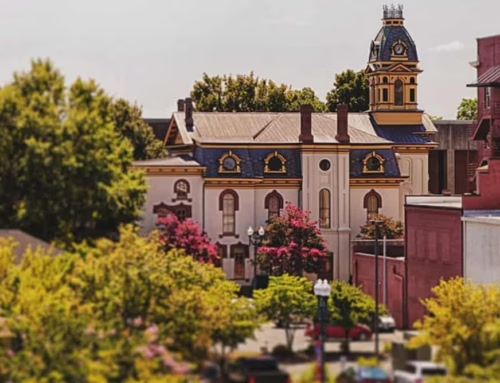
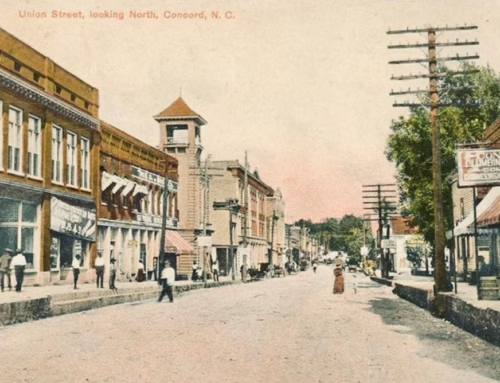
The small town had muddy streets and frame buildings, without sidewalks or street lamps. Still, it had the small cotton mill, started in 1839, and another valuable asset: the North Carolina Railroad ran just to its west, so cotton and other goods could easily be shipped to market. The town also had a stately courthouse, which was destroyed by fire in 1875, and replaced the following year by the lovely structure that is now the Historic Cabarrus County Courthouse.
County government in North Carolina was restructured during the Reconstruction Era with the creation of the County Commission form of government, which included elected boards. The old system of the Courts of Pleas and Quarter Sessions was abandoned for a time, but in 1875, the laws were amended to provide that County Commissioners served under the Justices of the Peace. By 1895, most Counties elected Commissioners who were not subject to the control of the Justices of the Peace. By 1905, the system was made uniform all across North Carolina.
Towns grew larger after the War. Wilmington had a population of 10,000 people in 1870, while Concord numbered about 800 citizens that year. By 1880, Asheville, Charlotte, and Raleigh had each reached 10,000 residents. City governments began addressing the problems of providing potable water, public transportation, and electric and telephone services. Most of these services were initially furnished by franchised private companies until the turn of the century. School districts operated schools, and the cities and towns predictably had better schools than the rural areas. The larger cities began paving streets to meet demand for better paving and utilities. Public health regulations were more comprehensive and were more strictly enforced. In Concord, the growth of the textile industry led to population growth and job opportunities, greater capital investment, and strengthened confidence in the City's future.
Captain J. M. Odell, a native of Randolph County, purchased the old steam-driven Concord Cotton Factory at a foreclosure sale in 1877. The old plant had 1,500 spindles and no looms. By 1892, Captain Odell had added three more mills to his original plant, with 21,000 spindles and 846 looms. A town of 800 people, Forest Hill, grew up around his mills, just to the North of the Concord boundary. The only bleachery in the South was also located there, and could treat 40,000 yards of cloth a day. A new enterprise, the Kerr Bag Manufacturing Company, shipped large quantities of bags nationwide.
Meanwhile, J. W. Cannon applied himself to his work as a merchant and learned the business of cotton buying. Before he was 21, young Cannon had already established a reputation for hard work and integrity. In 1887, he organized the first of his textile companies in Concord. As demands for "Cannon Cloth" grew, he opened a new plant in Concord in 1892 near the Railroad.
Inspired by the success of Odell and Cannon, an enterprising black businessman named Warren C. Coleman, a native of Concord born into slavery, launched what one biographer called a "noble experiment" by building a textile plant in Concord to be operated by African-American employees only. Mr. Coleman had made a fortune during the latter part of the nineteenth century through his mercantile activities and real estate investments. He was considered one of the wealthiest black citizens in North Carolina. He invested much of his fortune in a cotton mill; however, to demonstrate that his factory could produce high-quality textile goods, he employed black operatives in jobs usually reserved for white workers. Unfortunately, he died of a fever in 1904, and the business did not survive his passing. After his untimely death, the plant was acquired by the Cannon chain.
Although Warren Coleman is the best-known African-American businessman of his time in Concord, there were other well-known entrepreneurs as well. Charles Alexander operated a cement block plant and a rest home in Concord. He also formed a touring black orchestra, Alexander's Happy Pals Orchestra, which was quite successful in the 1920s and 30s. His son, James Henry Alexander, Sr., was a popular teacher at Logan School. After the integration of the schools, James Alexander moved to Concord Junior High (Middle) School, where he taught music and served as an assistant principal. His son, James A. Alexander, Jr., was a speech-writer for President Bill Clinton. Frederick H. Watkins, born in Rockingham in 1860, became the first African-American medical doctor in Concord, laying the foundation for others to follow. Dr. Watkins died in 1925.
The Concord textile men soon came to need their own bank; though they could fund it, they needed a remarkable man to run it. They found their man in Daniel Branson Coltrane, a Confederate veteran who had ridden with "Jeb" Stuart's cavalry in the War and survived three wounds in battle. He returned to his native North Carolina from Missouri in 1888, and Concord National Bank opened in July of that year.
With the success of the great mills, no city in North Carolina had more vitality and excitement than 1890 Concord. The town's population had more than doubled, from 1,600 in 1880 to 4,000 by 1890. Near the depot, R. A. "Bus" Brown was forming 35,000 bricks a day at his new steam-driven plant, trying to keep up with all the construction in town. From the depot, visitors to town could ride up the hill into town on the new steam street railway, the "dummy line." Salespeople could find lodging at the elegant new St. Cloud Hotel or the Morris House. By 1900, Concord's population had swelled to 8,000 persons.
Concord's excellent public school system was established in 1891 when schools were approved by a margin of only three votes at an election held in May of that year. E. P. Mangum of Chapel Hill served for several years as the first superintendent of the Concord City School system, which had six teachers at the time. Frank T. Logan, a formerly enslaved person and a minister from Greensboro, was appointed Principal of Concord Colored School in 1891. The School became Logan School during a 1924 expansion. Rev. Logan's valuable legacy – and name - lives on after him, as the grateful Logan community bears his name.
During the early twentieth century, Concord adopted many of the trappings of a modern southern city. As in cities and towns across North Carolina, some streets and roads were paved to accommodate automobiles. Cities began to take over water and sewer systems as it became harder for private companies to meet citizens' demands and make a profit. Likewise, several towns acquired the electric systems that local businesspeople had operated since the War. To meet the needs of rapid population growth, city police departments were established, and fire brigades were formed to work alongside volunteer departments. That became even more important in Concord after much of the downtown was damaged by fire in 1885. Building codes were adopted, and libraries supported. The cities began to take on the contours of modern municipalities, and Concord was among them.
A city fire department was officially organized on December 21, 1900, replacing the all-volunteer Concord Hose and Reel Company, which had operated since 1887, and the Concord Hook and Ladder Company, composed of black volunteers. John L. Miller led the City Fire Department, aided by L. T. Biles, a paid employee, and volunteers. The Hook and Ladder Company was led by Foreman Martin Boger, Secretary Julius Harriss, John Causan, and about 20 active members. The City fire department was housed in the new city hall building on South Union Street. Other city offices in the modern three-story building were those of the Chief of Police, J. L. Boger, the City Tax Collector, Ross McConnell, and the Mayor, J. B. Caldwell. Traveling companies used an "Opera House" on the second floor for Shakespearean plays and vaudeville shows. Public meetings and local entertainments were also held in the hall.
Efforts to establish a local library began in 1902, when a Board of Directors was appointed on July 8. The library was reorganized in 1911 when the Board of Aldermen appointed a Board of Directors composed of dedicated Concord citizens led by Mrs. L. D. Coltrane.
James P. Cook, editor of the Concord newspaper The Standard, led an effort to remove young boys from the state prison system and place them in a "training school." Seventeen years of effort led to the formation of the Stonewall Jackson Manual Training School, with Mr. Cook as its first Chairman and D. B. Coltrane as Treasurer.
Concord was also transitioning from horse-drawn carriages to modern transportation during those first decades of the new century. In 1908, the Board of Aldermen approved a franchise for a street railway. The inaugural run of the battery-powered streetcar in the United States took place in Concord in the fall of 1910, to considerable local enthusiasm. However, the battery needed constant recharging, and the car proved unsatisfactory. It was replaced in 1912 by a traditional trolley car, which operated along the old tracks for another decade.
The City continued its steady growth, its population increasing from 7,910 in 1900 to 8,715 in 1910 and 9,903 a decade later. In 1911, a modern post office was constructed on South Union Street, near St. James Lutheran Church. Interested Concord citizens petitioned for a Red Cross Chapter Charter in April of 1917, and the chapter began writing a history of service, with Mrs. C. A. Cannon as Chairman and Mrs. L. D. Coltrane as Secretary.
During the early decades of the twentieth century, the residents of Concord witnessed the first great world conflict, the Spanish Flu epidemic, the boom times of the 1920s, and the beginnings of a massive worldwide depression. During those decades of growth, the population of Concord increased from about 9,000 persons in 1916 to about 13,500 persons in 1936. Four miles of bituminous streets had risen to 21 miles of paved roads in the City. At the same time, deposits at city banks had swelled to more than 7.5 million dollars, with another 2.7 million dollars in the three savings and loan associations. Savings banks boasted another 2 million dollars in assets. The City's principal industries included cotton manufacturing and hosiery mills, bleacheries and finishing plants, an oil mill, an ice plant, lumber mills, a foundry, and a gas plant, as well as two wholesale grocery houses that served Cabarrus County and parts of all the surrounding counties.
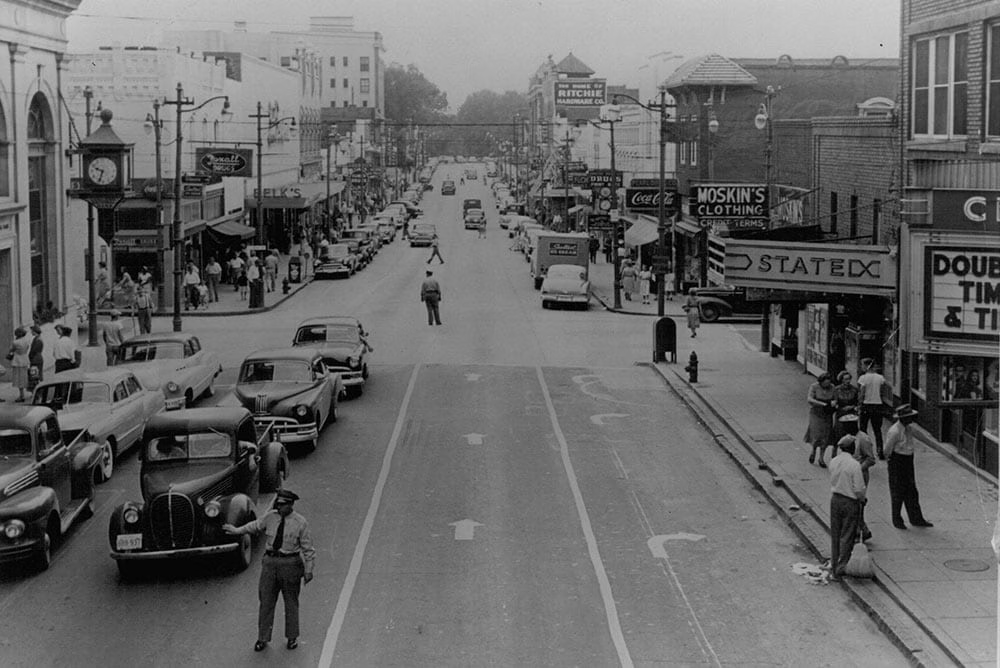
According to a 1954 special issue of The Concord Tribune, the population of Cabarrus County in 1950 was 63,910, of whom 16,720 lived in Concord. The County had just completed the sesquicentennial celebration of the discovery of gold in the eastern portion of Cabarrus County in 1799, on land owned by John Reed, a former Hessian soldier. It was the first authenticated discovery of gold in the United States. Countywide, property tax valuation in 1953 was more than $97 million, and Concord's was more than $26 million. There were three banks in Concord, none of which had ever sustained a bank failure. The community was served by a public library in Concord and a bookmobile, and protected by a police force of 31 men and a fire department with five fire trucks and one hose truck. Although there were still 15 volunteers to assist with fire protection, the department employed 15 paid firefighters. Local Cabarrus Memorial Hospital was undergoing renovations to become a 300-bed facility. The City was governed by an elected Board of Aldermen and a Mayor, all of whom were said to be businessmen, who ran the city "on a business basis."
The mid-century began as a time of segregation, but changes were gradually coming. In 1952, Lawrence Evans was the first black policeman hired by the Concord Police Department. While the 1950s were a difficult time to serve for black officers, Mr. Evans was well-regarded and attained the rank of Sergeant. David "Chalk" Steele also joined the force and became a Sergeant. Evans and Steele encouraged Julius Franklin to join the Concord force, and Mr. Franklin became the first African-American officer to attain the rank of Lieutenant. Edie Moss was the first black female police officer in the City. Hired in 1985, she was well known for the compassionate way she treated everyone she encountered, regardless of their position or situation. Ms. Moss served faithfully for 30 years.
Integration also brought more visible positions to black citizens interested in a lifetime of service in education. Betty Evans Eddleman was the first African American woman elected to the Concord Board of Education in 1969. In 1982, Betty Bruner-Alston was the first black female elected to the Cabarrus School Board. When the two systems merged in 1983, the two women served together on the combined Board. Ms. Alice Steele-Robinson devoted her life to education. She graduated from Logan High School in 1961; after school integration, she was appointed Director of Elementary Education. In 1995, she became involved in the Academic Learning Center, which provides tutors for children in the lowest-income City schools.
By 1985, Concord had a population of about 18,000 persons and was poised for its most significant period of growth. On June 30, 1986, the City annexed 8.06 square miles of land along its western and southern boundaries, increasing its population from 18,465 to 26,149. The highly developed area was rich in industry, and included the vast $100 million Phillip Morris, U.S.A., cigarette manufacturing complex. The giant motorsports complex centered around Charlotte Motor Speedway was already part of the City as a result of an earlier annexation.
In 1991, an additional 3.66 miles was annexed to the City. On February 2 of that year, Phillip Morris announced a $400 million expansion of its Concord plant, the most significant industrial expansion in the State's history. Oiles American Corporation, a manufacturer of self-lubricating industrial bearings and the first Japanese firm to locate in Cabarrus County, began construction of a 30,000 square foot facility as the first tenant of the Concord International Business Park. The second tenant of the Park, Seymour/Legrand, a manufacturer of electrical devices, completed construction of its manufacturing facility in December 1991.
As it neared its Bicentennial Celebration, Concord enjoyed many of the advantages of small-town life and remained a progressive community.
After the settlement of a dispute with Cabarrus County over a regional airport facility, the Concord Regional Airport became a reality. The City and Cabarrus County also formed a countywide water and sewer authority to provide necessary services and plan for orderly growth. In another successful litigation case, Concord established a municipality's right to refinance bonds at a lower rate by issuing new bonds. This decision was significant to cities across North Carolina.
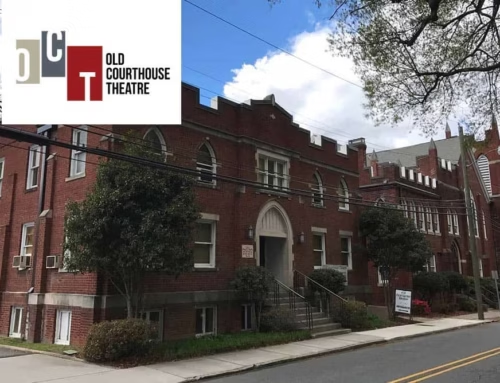
Quality cultural experiences were provided to Concord residents through the Old Courthouse Theater and numerous local civic and arts groups, such as the Cabarrus Arts Council. The City made extensive improvements to Les Myers Park, a city-owned facility, and purchased 310 acres of land between the Concord Regional Airport and the Charlotte Motor Speedway for a city-owned golf course and recreational area. Cabarrus Memorial Hospital, with recent extensive additions, was offering the best modern medical care to area residents.
As it neared the end of the twentieth century, Concord faced many of the problems shared by most other cities of the New South: the flight of merchants from downtown business districts; the demand for more governmental services without increases in tax revenues; the need to diversify the tax base and grow good jobs by attracting business and industry; and the search for funds to ensure quality educational facilities for the City's children. The Concord Downtown Redevelopment Corporation was successfully working to revitalize the downtown Concord business district. The City dramatically expanded its boundaries and population with a December 31, 1995, annexation of 13.75 square miles to the South and west of the City, including the residentially thriving regions along Weddington Road, Poplar Tent Road, and NC Highway 73. The annexed area increased the City population by some 6,200 residents. The City sought to address the school population explosion through new construction, and City leaders sought to attract more businesses to strengthen the tax base without adding more young residents to already crowded schools.
As Concord began planning her month-long Bicentennial Celebration in April 1996, she looked back on two centuries of progressive government and industrial growth. She stood poised for the greater challenges of the new century, confident that she would build on and grow from the solid foundations erected over two centuries of vision, sacrifice, and achievement.