Stephen Cabarrus: From Bayonne to the Birth of North Carolina’s Democracy
Compiled by Historic Cabarrus Association Staff
When Stephen Cabarrus arrived in North Carolina in 1776, he carried with him more than the hopes of a young immigrant—he brought a legacy of refinement, intellect, and public spirit that would help shape the foundations of a new state.
Born in Bayonne, France, Cabarrus was part of a prominent family of merchants and ship owners. His lineage included notable figures in European finance and politics—his cousin François Cabarrus was a well-known banker, and François's son-in-law, Jean Lambert Tallien, would later play a decisive role in ending Robespierre's rule during the French Revolution.
A New Life in the New World
Seeking opportunity in the New World, Stephen Cabarrus landed in Edenton, North Carolina, in 1776. Not long after, he married Jeanne Henriette Damery Bodley, the wealthy widow of Joshua Bodley, Lord Granville's final agent in the colony. Through the marriage, Cabarrus became the master of Pembroke, a sizable plantation near Edenton, and soon after established his own estate—Bayonne—named for his French birthplace.
By 1777, he had amassed nearly 2,000 acres of land and more than 60 enslaved people, a testament to the wealth and influence he gained early in his American life. Joined by his brothers Dominique, Thomas, and Auguste, Stephen would later adopt his nephews Thomas and Augustus after tragedy struck the family.
A Statesman Devoted to His Adopted Home
Stephen Cabarrus quickly became known for his intelligence, civility, and sense of public duty. Governor Alexander Martin praised his "attachment to the public interest," and the citizens of Edenton took notice. In 1784, they elected him to represent them in the North Carolina House of Commons, where he would serve for more than two decades, including several terms as Speaker of the House.
Cabarrus's legislative career was marked by service on key committees and a steadfast belief in good governance. He played a significant role in the debates over the U.S. Constitution—first as a delegate to the Hillsborough Convention of 1788, which rejected ratification, and again at the Fayetteville Convention of 1789, which finally approved it. Though unsuccessful in two campaigns for Congress, he continued his service as a presidential elector in 1792 and later aligned himself with the emerging Republican Party.
Champion of Education and Unity
Among Cabarrus's lasting contributions was his advocacy for education. In 1785, he sponsored a bill to designate part of the Edenton town commons to the proposed Smith's Academy, and later supported the creation of a state education fund. His dedication to learning was recognized when he was named one of the first trustees of The University of North Carolina in 1789. This institution continues to carry forward North Carolina's spirit of enlightenment and progress.
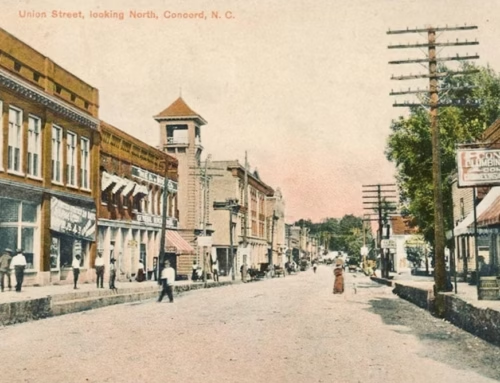
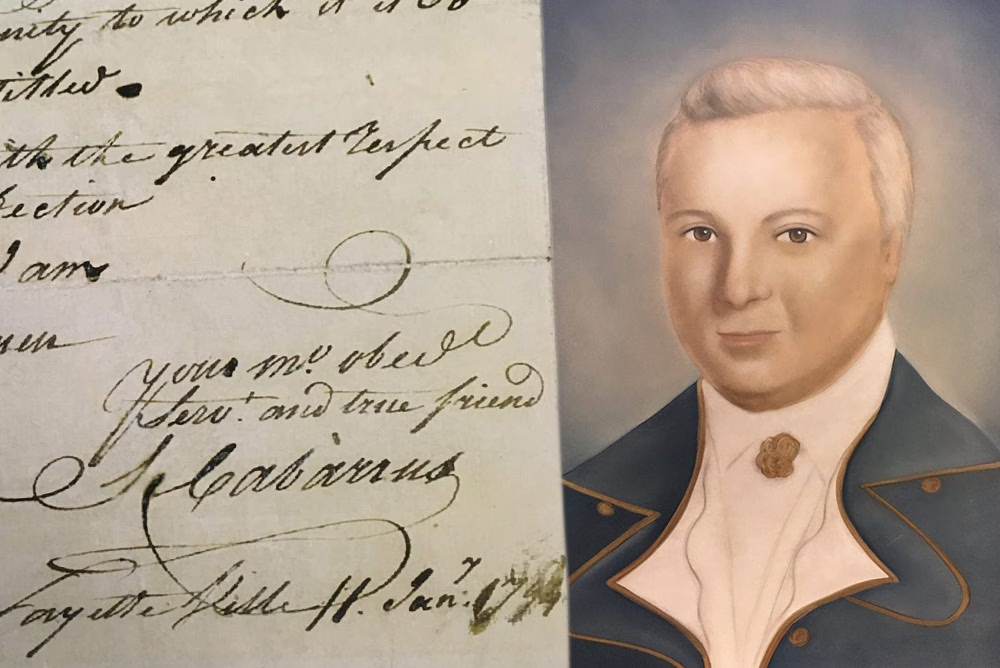
Cabarrus's name lives on not only through the university but in the geography of the state. As Speaker, he presided over the decision to establish Raleigh as the permanent capital, and both the city and the state honored his service by naming Cabarrus Street and Cabarrus County in his memory. When disputes arose over the location of the new county's courthouse, Cabarrus personally wrote to its divided citizens, encouraging compromise and unity. His counsel worked—the new county seat was dubbed Concord, and its main thoroughfare, appropriately, Union Street.
Legacy of Leadership
Beyond politics, Cabarrus was active in the Masonic community, serving as a delegate to the 1787 Tarboro convention that reestablished the Grand Lodge of North Carolina after the upheaval of the Revolutionary War.
Stephen Cabarrus's life blended Old World distinction with New World optimism. From his French roots to his North Carolina legacy, he embodied the principles of service, education, and unity that helped build a young nation.
He and his wife, Jeanne, had one daughter, Henriette, who passed away in childhood. Cabarrus was initially buried at his country estate but was reinterred in 1911 at St. Paul's Episcopal Church in Edenton—a fitting resting place for a man whose life's work helped shape both his community and his state.