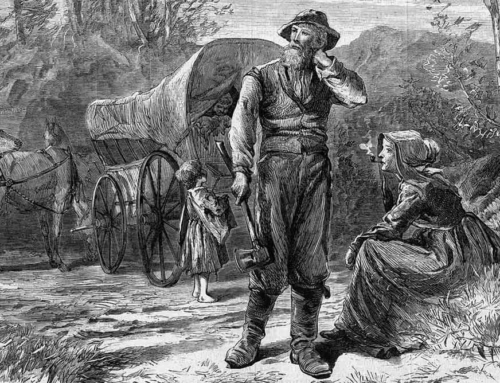
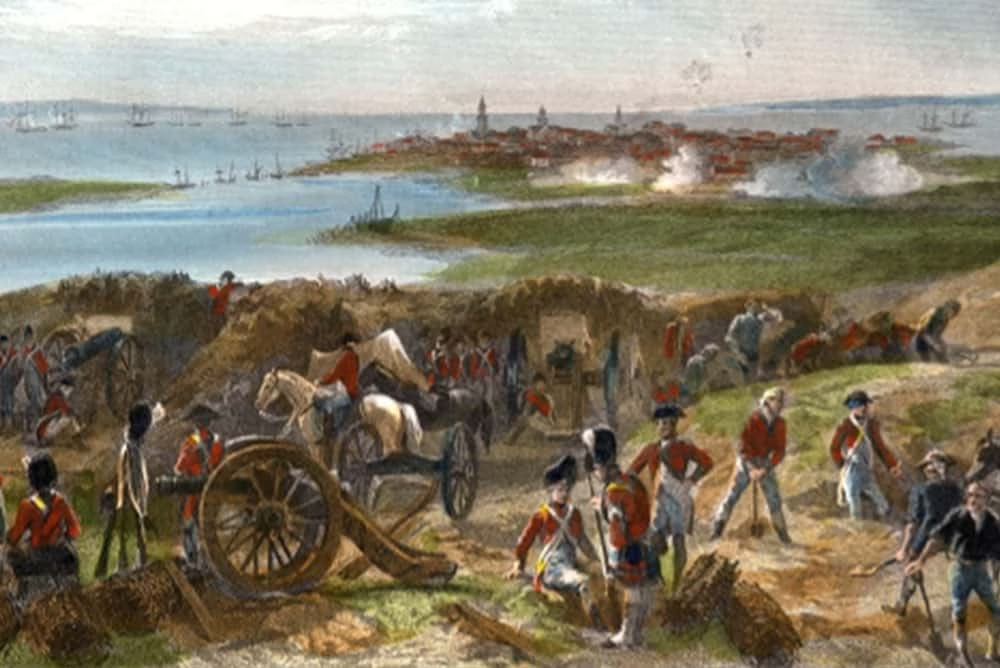
Private Elias House, the Siege of Charleston, South Carolina, and Soldiers he served with in the Mecklenburg Militia Company
Compiled by John Earl Ferguson Misenheimer, III
In recognition of the celebrations leading up to the 250th Independence Day anniversary on 4 July 2026, this is part three in a series of stories about American Revolutionary War troops who resided in the part of Mecklenburg County that became Cabarrus County in 1792. The series aims to present a more complete story of their experiences, using their own words and those of those they served with, as recorded in state and federal pension files at the National Archives in Washington, DC.
At Charleston, both Continental and Militia troops combined to make the American Southern Army under Major General Benjamin Lincoln, who commanded the garrison in Charleston. One can only imagine the sight of the Navy ships of the British Crown Forces entering Charleston harbor. They had traveled south from the State of New York down the Atlantic coast carrying British commander, General Sir Henry Clinton, and Lt. General Charles, Lord Cornwallis, second in command.
The British strategy had shifted from the northern states to the southern states after the Battle of Saratoga, due to a stalemate with the American Army under the command of General George Washington in the North. The British Government High Command in London decided to head south with their new strategy to "roll up the carpet" in the southern states, starting with Georgia. The Siege of Savanah resulted in a surrender on October 18, 1779, causing Georgia to be the only State to revert to a royal colony. The vast majority of Patriots in Georgia became refugees in South Carolina and North Carolina.
The fall of Georgia was a clear sign for North Carolina to protect the coast and send forces to South Carolina. For this reason, North Carolina ordered its military districts, including the Salisbury Military District, to send county militia troops to the aid of Charleston.
Hence, the Mecklenburg County Militia in the Salisbury Military District was called into action. General Griffith Rutherford sent orders to all the colonels and commanders in each county militia under his authority. A general "Call to Arms" was issued, and each soldier was to report to their own "mustering grounds."
Pvt. Elias House lived in the German-speaking community that was around Saint John's Lutheran Church in the northeastern corner of the County. It is said that when he heard the call, he told his father, Mark House, that he was going to support the "Cause of Liberty!"
Mark House was well known in the community and had been a soldier in the French and Indian War. [1] He also supported the Patriot cause. In 1778, he was a Mecklenburg County tax collector. The taxes provided revenue for the County to supply equipment to the local Militia. Mark was later identified as a Patriot for delivering services in support of the Militia.
Regardless, North Carolina State law stated that all males from the ages of sixteen to sixty years old were "bound to bear arms," and to serve in the local county militia. Pvt. Elias House reported to the Saint John's community muster grounds, under Captain James Osborn, and marched off to Charlotte Town (now the City of Charlotte), the Mecklenburg County seat.
Nine militia companies formed the Mecklenburg County militia regiment: the Company of the Saint John's Lutheran Church and German-speaking community, another company from Charlotte Town, and seven other companies from the seven Scot-Irish communities of the seven Presbyterian Churches in Mecklenburg County, including (Cabarrus County's) Rocky River Presbyterian Church and Popular Tent Presbyterian Church. Ideally, the officers of the German-speaking troops were bilingual in English and German, or had a translator from the German community.
Many of the soldiers were either first- or second-generation immigrants who came to the American colonies through Pennsylvania and then traveled down the Great Wagon Road, which crossed the Yadkin River at Trading Ford into Salisbury, North Carolina (today's Hwy 29), and then on to Charlotte Town. The road went into the heart of Charlotte Town to where the Mecklenburg County Courthouse stood in the intersection of Trade Street and Tryon Street.
This is the same courthouse where it is said that citizens of Mecklenburg County declared their independence from British rule on May 20, 1775, and established a set of radical resolutions for self-government, known as the Mecklenburg Resolves, on May 31, 1775. Lt. Col. John Phifer of the German-speaking community is identified as a signer of the Mecklenburg Declaration of Independence.
One can imagine that Pvt. Elias House, who lived in a rural section of the County, must have been amazed to see Charlotte Town filled with the multitude of soldiers all in one place. Some of the faces and names he already knew; others would have been strangers. However, as a "Band of Brothers in Arms" under militia Captain James Osborn, they would travel together to Charleston and fight in the Siege of Charleston under American Army commander General Benjamin Lincoln. Pvt. Elias House's story would not be complete without the inclusion of the men who fought by his side.
The following is a list of soldiers in Captain James Osborn's Saint John's community militia. The list is incomplete because it is based on those who survived long enough to become eligible for a pension passed by an Act of Congress in 1832. Additionally, there are exceptions regarding disabled veterans and earlier officer pensions. [2]
- Elias House
- George Barnhardt
- Thomas Campbell
- John Cochran (Cockran)
- John Davis
- Jacob Dry
- Conrad Krump (Crump)
- Jonas Leib (Lipe)
- Samuel Monteath (Monteith)
- David Montgomery
- Andrew Stough
- Caleb Toup
- William Smith
- John Stephenson
What follows is a compiled narrative told through eyewitness accounts from those who participated in the Siege of Charleston under the command of Captain James Osborn from Mecklenburg County. It is retold in their own words as reported in the pension applications of the above-identified soldiers. It began when they answered the Call to Arms in early March 1780. [3]
We mustered into the Company within our own community, serving at the Church meeting-house at Rocky River in Mecklenburg County. We then rendezvoused at Charlotte, where we formed a single Battalion and various Regiments from all the Companies that gathered there. One of these soldiers' recollections is that he was attached to the third Regiment of Militia…, and was in the Company under Captain James Osborn.
We marched under the officers Captain James Osborn, Lieutenant Harris, Lieutenant Andrew Alexander, Lieutenant Patterson, Ensign Joseph Shinn, Major Thomas Harris, Colonel John Alexander Lillington from Charlotte, N.C., and our Company was known by the name of the Charlotte Company. Also, Colonel Lillington left shortly after a few days. Then we continued under the command of Colonel Arrington [probably a reference to Henry William Harrington], who marched us through South Carolina into Charleston, S.C.
The route we took went on down through Camden, S., on into Charleston, S.C. When we reached Charleston, it was besieged on Land by the British & we got into the City by water, going down the Cooper River. We boarded vessels on the Cooper River. Our Company then embarked on our boats near Moncks Corner, taking water from approximately 10 to 11 miles above Charlestown. We proceeded into Charleston, arriving on March 28, 1780. At the time we entered by boat, we knew the Enemy had not yet fully invested the place. Shortly thereafter, the Siege or blockade became complete, surrounding all of Charleston both by Land and water.
We first went to Moncks Corner, and it was there that news came of Col. Banastre Tarleton being in the neighborhood. Then the detachment was marched or turned to the left to avoid pursuit, and we arrived at a place called Strawberry. From thence at Strawberry to Wadboo Cuts [Wappoo Cut ?]. We took to the water in boats on the Cooper River for Charlestown, and we landed at Gadsden's Wharf, arriving finally in Charlestown, South Carolina.
After arriving there, our Company was placed under General Benjamin Lincoln of the Main American or Continental Army. It was sent with others to strengthen Colonel Francis de Malmedy, Marquis of Bretagne, a native Frenchman. We had frequent skirmishes from the lines or breastworks with the Enemy, and continued the defense after we reached there for about two months. The Enemy frequently broke through the first line of circumvallation.
It was on May 11, 1780, that Elias House lost his left arm from a cannonball direct hit, taking it off, and imagine that was just one day before the surrender. Commonly, there was a surgeon in the American Army to care for the wounded as well. It's fantastic that Elias House survived, because loss of blood, including the potential of infection, and the medical supplies and resources at the battleground in a siege warfare were scarce after around two months of daily fighting too.
Due to the scarcity of provisions, we had to live for about six weeks on sugar & coffee without meat or bread.
We remained there under the American Army Regular officers until the capitulation & surrender to Sir Henry Clinton, the General and commander of the British Army, on May 12, 1780. We were in the Siege of Charleston, and we were taken as prisoners. Since we belonged to the State Militia Troops, we were put on parole, which remained in effect until we were either exchanged or released, as stated in the parole.
We remained as prisoners for about eight days until May 20, 1780. During their eight days as prisoners under Clinton & Cornwallis, the British offered each militiaman a strong incentive to enlist in the British Army: $50 cash, a suit of Regimentals, and a share of the Spoils or booty of the City. We refused and were finally paroled on condition that we should not take up arms against them.
Another soldier's experience taken as a prisoner at this place, and detained for about eight days, we were only to have been arrested for six days. But the night before we were to be paroled, a ship was blown up, and the day the parole was to have taken place, the American Magazine, then in the possession of the Enemy, also exploded. This took place when we were paraded to be paroled, and in consequence of this, we were detained.
The three months had nearly expired when we were taken prisoners. We remained as prisoners until after the three months and were exchanged and never returned to Charleston, S.C. Most of the Company served out the full term of their service, three months. [4]
It is clear that Pvt. Elias House greatly sacrificed himself in battle on May 11, 1780, just one day before the final capitulation and surrender on May 12 12 1780, to British General Sir Henry Clinton. Due to the severity of his injuries, his survival very likely depended on a medical officer from either the American or British Armies (it was not uncommon for the British to render aid to enlist recruits to their side). Although he recovered from the loss of his left arm in a military hospital at Charleston, it would have still been a hardship for Elias House to return home; however, his family must have been relieved that he survived. As a direct descendant, I am incredibly thankful. He later married Elizabeth Cress and had a daughter, Katherine House, born on June 13, 1790. Katherine married my fourth great-grandfather, George Misenheimer, Jr. As I like to say, the rest is family history.
Based on the documented evidence, Elias should have been eligible for the Badge of Military Merit, established by George Washington on August 7, 1782. Known today as the Purple Heart, it is the oldest active United States military award.
The process to obtain his pension benefits demonstrates that Elias House was resourceful and well-versed in the legal process. The fact that his signature appears in the pension file, rather than an "X" mark, shows that he was literate. Winston Churchill is quoted as saying, "Never Give Up, Never Give Up, and Never Give Up!" I believe that my fifth great-grandfather embodied these words, for he had to wait many years to be awarded a military pension for his lifetime disability.
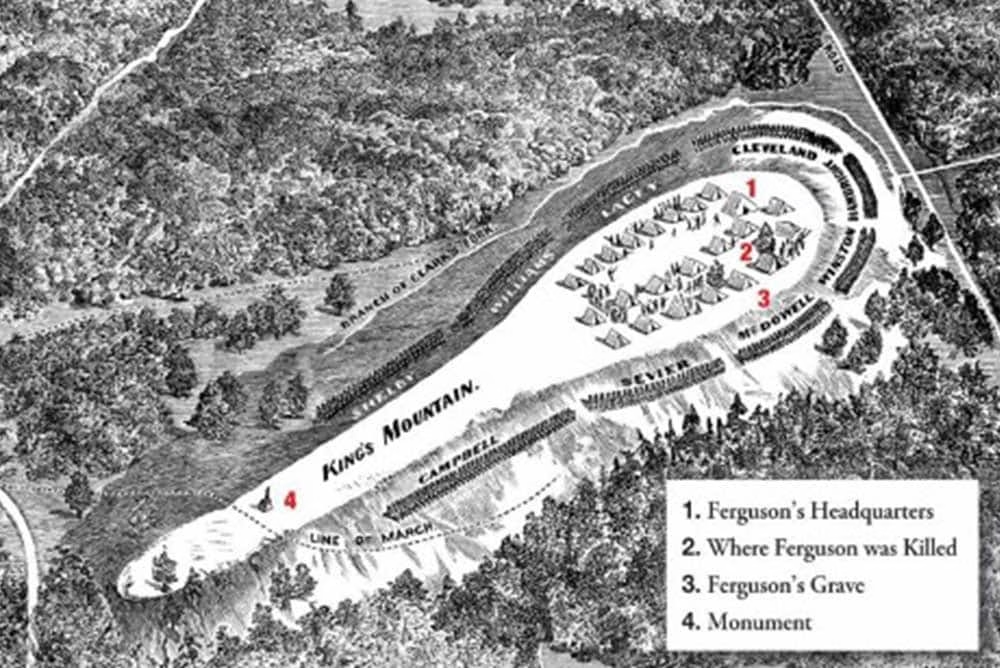
Diagram of the Battle of King’s Mountain
This “Diagram of the Battle of King’s Mountain,” shows the 1,000-ft. ridge where Major Patrick Ferguson and his Loyalists were attacked by Patriot riflemen from the wooded slopes. Lyman Copeland Draper, King’s Mountain and Its Heroes: History of the Battle of King’s Mountain, 1881.
transcriptions of military pensions
The following are transcriptions of the military pensions of Elias House and the men who served with him in Captain James Osborn's Saint John's community militia company, Mecklenburg County, Salisbury District:[5]
HOUSE, Elias, a militia soldier drafted from Mecklenburg Co. in 1780, serving under Capt. James Osborn at Charlestown, where a cannonball shot his arm off, received a certificate allowing him £12 annually, but he was never able to obtain the sum. His father [Mark House] died in January 1789, leaving a numerous family to support in addition to the petitioner's own. He asks for £12 per annum from May 11, 1780. Sworn to before Capt. JAMES OSBORN, Mecklenburg Co., August 9, 1793. Commissioners' certificate signed by ANTHONY NEWNAN, EDWARD YARBOROUGH, and LEWIS BEARD of Rowan County, September 19, 1793, states they examined said House, October 23, 1786, and felt he was entitled to the pension. (L.P. 123). In Senate and House, December 16, 1793. The same day, he signed a receipt to JOHN HAYWOOD, public treasurer, for L163.3.4, the amount. Due to him on an annuity. (L.P. 128). Article Source in the Publication: N.C. Genealogical Society Journal, July 1975. "Private Petition to N.C. Legislature, Revolutionary War Service Related Benefits" – Delamar Transcripts.
Elias House Pension Application, S24216 fn13NC
From North Carolina to Illinois, Elias House, private, in the Revolutionary Army, Inscribed on the roll of North Carolina at $4.50 [per month] and increased to $7.20 per month, by law 24 April 1816: Found certificate issued September 27, 1824, and sent to D. A. Davis, Esquire, Fayetteville, NC
County of Union, and State of Illinois: SS
On this 9th Day of August A.D. 1824, before me the Subscriber, an acting Justice of the Peace, for the County of Union and State of Illinois, personally appeared Elias House, now a citizen of the County of Jackson and State of Illinois, but late of the County of Cabarrus and State of North Carolina, who on his oath declares, that he is the same person, who formerly belonged to the Company commanded by Captain James Osburn [James Osborn? or James Osborne] in the Regiment commanded by Colonel Harrington of North Carolina in the Service of the United States; that his name was placed on the pension roll of the State of North Carolina but has never received a formal Certificate, and now wishes to obtain one. Sworn and subscribed to before me the day and year aforesaid,/S/M. Collier, JP
Note: There is no pension application in this file; however, author Lloyd de Witt Bockstruck notes the following: "House, Elias, N. C. Pvt. he applied in Cabarrus on August 9, 1793. He served in the Militia from Mecklenburg County under Colonel Harrington. He was disabled at the Siege of Charleston, South Carolina, in 1780 by a cannonball that took off his left arm. He served under Captain James Osburn. His father had died in January 1789, so he had two families to support. He was on the 1813 pension list."[6]
George Barnhardt/Bernhardt Pension Application, R544 Mary Barnhardt f25NC
"I was a volunteer in the County of Mecklenburg, and the part of the County now called "Cabarrus" for three months under Captain William Osborne, Lieutenant Harris, Major Harris, Colonel Lillington [John Alexander Lillington]. We rendezvoused at Charlotte. There was but one Regiment of us. Colonel Lillington left us after a few days, and we marched under the other officers mentioned from Charlotte, N., through Camden, S.C., to Charleston, SC. We boarded vessels on the Cooper River & went into Charleston with them – and were placed under the command of General Lincoln [Benjamin Lincoln] of the Main Army, Colonel Malmeda [Francis de Malmedy, Marquis of Bretagne]. I volunteered around March 1, 1780, and arrived in Charleston by the end of March. Remained there under the Regular officers until the capitulation & surrender to the British on May 12, 1780. I was in the Siege of that place, and was taken prisoner, and, being of the Militia, was put on parole, till we were exchanged or released, as the parole read. The three months had nearly expired when I was taken prisoner. I remained a prisoner for three months and was exchanged and never returned. I served out the full term of my service, which was three months.
Thomas Campbell Pension Application, S8169 f23NC
He entered the service, in the Militia he thinks March 20 1780 as a soldier in the Company commanded by Captain James Osborn, Lieutenant Andrew Alexander, Ensign Joseph Shinn for the term of three months, marched by Major Thomas Harris, through the State of South Carolina to Cooper River, under the command of Colonel Arrington, by water, to Charleston & there was under the command of General Lincoln, & was sent with others to strengthen Colonel Malmedy after the capitulation, I received a parole and returned to my [home].
State of North Carolina, Cabarrus County: Personally appeared George Barnhart and after being duly sworn saith that he was well acquainted with Thomas Campbell during the Revolutionary War & that he recollects well that he served at the Siege at Charleston, he thinks in the year 1780 – Sworn to & subscribed this 16th day of October 1832. S/ Geo Bernhardt
John Cochran (Cockran) Pension Application, S16720 f17NC fo
…he mustered into the Company wherein he served at the meeting-house at Rocky River in said County of Mecklenburg… That afterwards in the month of March 1780 he told affiant volunteered in the County of Mecklenburg aforesaid under the command of one Captain Osborn [probably James Osborn] and was mustered into a Battalion under the command of Major Thomas Harris; that he this affiant marched with the troops under the command of said Major to the town of Charleston State of South Carolina and there after entering the City, entered under the command of General Lincoln [Benjamin Lincoln] at that time commanding the American troops in Charleston as aforesaid; That he this affiant remained under the command of said Lincoln in Charleston until about May 12 (as he thinks) when the troops under said Lincoln's command with this affiant were surrendered to Sir Henry Clinton the commander of the British forces at said place, that he remained a prisoner for about eight days as he thinks until the 20th of said month of May when he this affiant with the Militia were paroled and permitted to return home under promise and they would not take up arms again until exchanged, that from the time he entered the service on this Tour, he was out about three months.
John Davis Penson Application, S3259 f44NC1
That he entered the Service of the United States under the following-named Officers and served as herein stated – about the age of 19 years, and in 1778,2, as he believes, he substituted himself in place of his brother Andrew Davis, who was drafted in the Militia of Mecklenburg County, North Carolina, and was mustered into service under Capt. James Osborn and marched from Charlotte, North Carolina, to Charleston, South Carolina under General Lincoln [Benjamin Lincoln], the names of Major and Col., not recollected. Charleston was then under siege3 and applicant was there in its defense, seven weeks, when it was surrendered [Charleston South Carolina fell to the British on May 12, 1780] – he was eight days a prisoner under Clinton & Cornwallis, they urged him very much to enlist in the British Army offered him $50 cash, a suit of Regimentals and a share of the Spoils or booty of the City, Applicant refused & was finally paroled on condition he should not take up arms against them, & he returned home, this engagement was for three months as applicant believes…
That he was born in what was then (or at his earliest recollection) called Mecklenburg County North Carolina in the latter part of the year 1759 or early in 1760 as he understood and believes, -- That he has no record of his age, never had any such record, and never saw any record of family ages in his father's family that no such record was kept by his father as he believes, and that all this applicant knows of his age is from the accounts he received from his family and neighbors, and that the ages of some near neighbors with whom he was brought up, and who were his companions in infancy and youth, and who had records of their ages.
Jacob Dry Pension Application, R3097 fn36NC
That he entered the Army of the United States in the year 1779 as a substitute for Jacob Grover [could be "Croner"], in the Company of Captain Osborn [James Osborn], in the Regiment whose higher officers were Colonel Caleb Fifer [sic, Caleb Phifer], Major Wright or Wiatt -- & Major Harris. The last of whom conducted the Company from Mecklenburg County, North Carolina, to the Siege of Charleston. Phifer & Wright, having been officers of the Militia at home, did not accompany Osborn's Company on this expedition. On reaching Charleston, we were placed under the command of Colonel McIntosh. At that time, the principal conduct & management of the defense of Charleston was in the hands of General Lincoln. We entered Charleston by descending Cooper River in boats, and at the time we entered, the Enemy had not fully invested the place. Shortly thereafter, the Siege or blockade became complete.
We had frequent skirmishes from the lines or breastworks with the Enemy, and continued the defense after the declaration reached there for about two months. The Enemy frequently broke through the first line of circumvallation, in consequence of the scarcity of provisions, having before doing so lived for about six weeks on sugar & coffee without meat or bread. The Enemy was commanded by Lord Cornwallis & Sir Henry Clinton. Your Declarant was taken prisoner at this place and detained for about eight days; they were only to have been arrested for six days. Still, the night before they were to be paroled, a ship was blown up – and the day the parole was to have taken place, the American Magazine, then in the possession of the Enemy, also exploded. This took place when we were paraded to be paroled, and in consequence of this, we were detained. He was on a three-month tour in actual service, but his parole was extended beyond the initial three months. Thus ended his first Tour of service. He will add that the Company to which he belonged embarked in their boats near Moncks Corner, a few days after the embarkation of about 2500 regulars; your Declarant was a private on this campaign. --- He was 16 years old when he started in Charleston, having just then been put on the muster roll. He was living in the County of Mecklenburg when called into the service. --- That he went into the service from Charlotte Court house in North Carolina and served three months, during which time he was taken prisoner by the British and was let off on parole by the British Officers, which parole he has lost so that he cannot now find it. He was in the Battle of Charleston. His Captain was named, as he now recollects, James Osborn. He cannot now remember the number of his Regiment nor the name of the Colonel who commanded it. Lincoln was the General.
Jonas Leib (Lipe) Pension Application, W1883 Christina fn54NC
That he volunteered in the Militia in the year 1780 (residing at that time in Mecklenburg County, North Carolina) under the following-named officers, Captain Osborne, Major Harris, Lieutenant Patterson, Ensign Joseph Shin [or Joseph Skin], known by the name of the Charlotte Company. He marched from Charlotte to Charleston, South Carolina, where he was taken under the command of General Lincoln & was under his command at the time of his surrender. He then returned home on parole, having served a term of 3 months.
[fn p. 18: copy of the marriage bond issued to Jonas Lipe and Leonard Lipe of the County of Cabarrus, State of North Carolina, dated October 20, 1801, to secure the marriage of Jonas Lipe to Ann Christina Huber of said County.] [fn p. 51] State of North Carolina Rowan County On this the 31st day of March, 1853, personally appeared before me, an acting Justice of the Peace in and for said County, Abraham Lipe, who being first duly sworn according to law, doth on his oath make the following statement, that he is the son of Joseph Leib late of Iredell County, who was a pensioner of the United States, by the first marriage of the said Leib: that his father was of German extraction and the name though pronounced Lipe, was in the German language spelt Leib, and this method of spelling the name was continued until within the last 15 or 20 years: that this affiant and his brothers and sisters when at school, all we use the German method of spelling the name, viz. Leib, and it was not until the family grew up & left their father, that the orthography, Lipe, in accordance with the English pronunciation of the name, was adopted. Affiant further states that Jonas Leib and Ann Christian (Huber before marriage) lived together from the year 1801 until the death of the said Jonas, as husband and wife, and were so reputed to have raised a large family of children. Affiant further states that Ann Christina Leib has not married since the death of her husband.
S/ Abraham Lipe
[fn p. 11: on February 23, 1853 in Iredell County North Carolina, Ann Christina Leib, 77, filed for a widow's pension under the 1853 act stating that she is the widow of Jonas Leib a pension or at the rate of $20 per annum for his services in the RevolutionRevolution; that she married him October 27 1801 in Cabarrus County North Carolina; that her name before her marriage to him was Ann Christina Huber; that her husband died June 10, 1843 and that she remains his widow.] [fn. p. 8: On April 9, 1855 in Iredell County North Carolina Christina Leib, 80, filed for her bounty land entitlement stating she is the widow of Jonas Leib and a pensioner in her own right at the rate of $20 per annum commencing on February 3, 1853; that she married Jonas Leib on October 27, 1801; that they were married by one Peter Cauble, JP in Cabarrus County North Carolina; that her name before her marriage was Christina Hoover; that her husband died at his own house in Iredell County June 10, 1843; that she remains his widow.]
Samuel Monteath (Monteith) Pension Application, W4745. Margaret Monteith, f34NC
I again entered the Service about 1780 as a drafted man under the Command of Capt. Osborn, who marched me from Mecklenburg to Charlestown, marching through Charlotte, as I live about 14 miles above there by Moncks Corner, and took water about 10 or 11 miles above Charlestown on the Ashley River, and sailed down to Charlestown, and there remained during the Siege. They joined the Army of General Green [sic, Nathanael Greene -- Sic, Benjamin Lincoln was the commander at Charleston during the Siege of that town, Greene did not arrive in the South until December 1780] and remained in Charleston during the whole Siege. Still, on the fall of Charlestown [Charleston, South Carolina, fell to the British on May 12, 1780], I was taken prisoner. I remained with them until I was paroled to go home on condition I did not lift arms until my parole was signed on May 20, making another three-month tour. I came directly home, taking the same road I had taken to Charlestown. I entered the services again about the year after getting home from Charlestown…
David Montgomery Pension Application, W4039. Margaret Montgomery, f36NC
The next regular Tour was for three months to Charleston under Capt. James Osborne [James Osborn] in Regiment of Col. Livingston [sic, John Alexander Lillington?] in the year 1780 or 1781 but knows with certainty that it was at the time the British Army besieged Charleston under General Clinton [Henry Clinton], we were in the town when it was taken [Charleston South Carolina fell to the British on May 12, 1780] & made prisoners of war & I was paroled and never served a regular tour again. However, I often volunteered against the Tories for a short time. I was drafted for a three-month tour for the Charleston expedition. When we reached Charleston, it was besieged on Land by the British & we got into the City by water down the Cooper River. General Lincoln [Benjamin Lincoln] was the Continental officer in command of Charleston. Still, I cannot say what regular or militia forces were there, for I have forgotten all of their names, except for our own Commanders, as previously stated. When the City was Surrendered to the British, I was paroled & then I took the best way I could home. After that, I served several times against the Tories. Still, it was only for a short time & never again was out on a three-month Tour.
Pension Application of William Smith, Pension Application, S7563 fn20NC
The second Campaign at York [sic. "that your"] Declarant was in was the Siege at Charleston, South Carolina. Lincoln was the General of the Army – the balance of the field officers your Declarant cannot recollect – James Osbourn was the Captain of the Company to which he belonged – there were Continental troops there, but your Declarant cannot remember their officers – Served about three months in this Tour as well as your Declarant recollects – Your Declarant states that he was taken PrisonerPrisoner at that place and was paroled home – has no documentary evidence of the fact.
Your Declarant states that he was born in Ireland in the year 1758 – That he has no record of his age – That he was living in the County of Mecklenburg & State of North Carolina when called into service That he is now living & has lived in the same County & State ever since the Revolutionary war…
John Stephenson Pension Application, S2020 fn21NC
…he was born November 10, 1755, in the County of Mecklenburg, North Carolina. In February 1780, he joined the service of the United States as a volunteer under Captain James Osburn [sic, James Osborn] in the Town of Charlotte, North Carolina. In a few days thereafter the detachment was marched for Charlestown South Carolina; first to Moncks Corner – where news came of Tarleton [Banastre Tarleton] being in the neighborhood, when the detachment was marched or turned to the left, to avoid pursuit; and arrived at a place called Strawberry, and from thence to Wadboo Cuts [Wappoo Cut ?]—and then took water for Charlestown – and landed at Gadsden's Wharf – At Charlestown he was attached to the Company of Captain David Crawford – He was at the Siege of Charlestown, by Cornwallis and Clinton, and was taken Prisoner – He was detained a prisoner ten days – and then paroled; and returned home. In this campaign, he was three months and fifteen or twenty days. He recollects that he was attached to the third Regiment of Militia, and that it was commanded by Colonel Arrington, or Harrington [probably a reference to Henry William Harrington], and that Thomas Harriss was the Major. As he returned from Charlestown, he met the Virginia Troops commanded by Colonel Buford, who the British attacked in South Carolina on a Creek called Crooked Creek. And he thinks that Colonel Woodruff commanded a detachment of regulars at Charlestown – and that they were marched to that City, immediately in advance of the Troops to which he belonged. After his return from Charlestown and remaining at home less than twenty days, he again volunteered his services…
… appeared personally in open court Joseph Knox2 and made oath that in the year 1780 & afterwards he was acquainted with John Stephenson who resided in the County of Mecklenburg North Carolina, and he recollects that said Stephenson attached himself to Captain Osburn's Company of Militia as a volunteer to march to Charlestown, and did march for that place, and he saw the said John Stephenson after the capture of Charleston, and soon after his return from thence; and Stephenson showed him his parole, which the British had given him – Said Stephenson transferred from Osburn's Company to that of Captain David Crawford at or near Charlestown –Stephenson was in service after his return from Charlestown under Captain Rodgers about the time that Cornwallis was taken – His first Tour of service to Charlestown was near four months – but what length of time he served under Captain Rodgers affiant does not know; but has heard it said by those who were in the same service, that it was four months or thereabouts.
Andrew Stough Pension Application, S7630 fn15NC
Again, in the same County and State, in April 1780, about the first of the month, I volunteered for three months and was placed under Captain William Osborne – & Major Thomas Harris – by whom we were marched from this State, from the town of Charlotte where we rendezvoused to the City of Charleston South Carolina – where we were placed under the General Command of General Lincoln – where we remained until the Siege and surrender of Charleston which was in May 1780. I was then taken prisoner and put on parole, which I have lost or destroyed. I served in this expedition for three months.
Caleb Toup Pension Application S7738 f15NC
In March 1780, I was hired as a substitute for Jacob Cooke in Mecklenburg County N. C. for three months was placed in the Regiment commanded by Colonel Alexander [George Alexander], Captain Osborne [James Osborn] – rendezvoused at Charlotte N. C. marched through South Carolina to Charleston – was in the Siege of the City –surrendered May 12 17802 – was taken PrisonerPrisoner and placed under parole – served out the three months and was discharged by Col. Alexander in July 1780.
Conrad Krump (Crump) Pension Application, S6599 f21NC
That in or about March 1780 he substituted in the place of John Burger in Captain Gabriel Enox [Gabriel Enochs'] Company was marched to Salisbury and inspected by General Rutherford [Griffith Rutherford] and marched on a tour of three months under Colonel Lillington [John Alexander Lillington] of the Militia to Charlotte & thence on to Charleston then besieged by the British & was forced to get into the City of Charleston in boats down Cooper River that he served in the Company of said Gabriel Enoch till the City was taken [Charleston South Carolina fell to the British on May 12, 1780] and detained a prisoner by the British for about the term of 12 months taken to the North and there detained until he made his escape on Long Island in the State of New York and reached home through the various rangers of the Enemy in the Jerseys just before Christmas in the year 1781 -- & that the British took all of his papers from him & that when he came home he found none of his officers as to be able to get a discharge & that he has no documentary evidence of his service and that he has no better testimony of his service than the affidavits of those who served with him as hereto annexed.
Questions by the Court:
Where were you born? Answer I was born in the government of Germany Prince of Hags [?] & came to this country in the year 1776 in the British service: taken PrisonerPrisoner at the Battle of Trenton [December 26, 1776], from thence brought to Elizabeth town & exchanged -- next taken by the British on to Georgia and deserted at a place called Ebenezer above Savannah went to Colonel White who commanded at Purrysburg and got a permit to come through the Country to Mecklenburg North Carolina to which place I got in the spring of 1779, and in the following year 1780 or early in the year I enlisted in the American Army by taking the place of John Burger as substitute as at first described.
I served under General Lincoln [Benjamin Lincoln] when he commanded in Charleston in the year 1780, and at the time the City was taken -- I never received a discharge from the American service for the reason the first set forth.
State the names of persons to whom you are known in your present neighborhood who can testify as to your character for veracity and good behavior, and annual service in the Revolution. Answer. I know John Copenning: John Boon, Esquire, Mark Brittain, and Elisha P. Miller, Alexander Perkins & Elisha Hayes Esquires, the three last of whom have certified for me. S/ Conrod Krump
State of North Carolina, Cabarrus County:
On this 13th day of October 1832 personally appeared before me Paul B Barringer, one of the acting Justices of the peace for said County -- George Barnhardt -- a resident of Cabarrus County, who being duly sworn, according to law -- says that he knows of the following service of Conrad Crump in the Revolutionary War -- "I know that Conrad Crump was a soldier in the service when Charleston was taken the May 12 1780 -- Conrad Crump was in a company commanded by Gabriel Enoch and had served near three months when the City capitulated in our Regiment. He was then taken prisoner with us. I also know that he remained in the Army for upwards of a year before returning to Mecklenburg County, North Carolina, where he lived. All the neighbors believed he had been a prisoner in the British Army all the time. I was in the camp in Charlotte when Crump came there as a volunteer sometime in March 1780."
S/ Geo. Barnhardt
State of North Carolina, Burke County:
Court of Pleas and Quarter Sessions October Court 1832 - David Montgomery swears that he well knew Conrad Crump during the Siege of Charleston by the British in the year 1780, that he Montgomery served in the Company commanded by James Ozborn [sic, James Osborne?] Captain & Lillington of the Militia Colonel and that Conrad Crump was a private in the said Regiment & remained so when the British took Charleston. Sworn to in open Court this October 23, 1832. S/ David Montgomery
[Facts in file: Veteran died September 18, 1836, place not shown; he had children surviving, but their names and the name of his wife are not stated in the file.] [Veteran was pensioned at the rate of $46.66 per annum commencing March 4, 1831, for service as a private for 14 months in the North Carolina militia.]
[1] In Europe, it is known as the Seven Years' War.
[2]https://revwarapps.org/s30957.pdf. I searched Osborn, Charleston, and Mecklenburg in the Southern Campaign American Revolution Pension Statements and Rosters, resulting in the names on this list.
[3] The narrative is based mainly on partial pension applications for the soldiers, but is directly related to the Siege of Charleston, S.C.
[4] One exception was Conrad Krump (Crump), who then volunteered as a Militiaman in the same Regiment. He was a former Hessian soldier who deserted the British Army and moved to Mecklenburg County, NC. His pension application is an interesting read, as the British Army had held him as a deserter.
[5] All transcriptions are from Southern Campaign American Revolution Pension Statements and Rosters, https://revwarapps.org/. Transcribed by Will Graves.
[6] Lloyd de Witt Bockstruck, Revolutionary War Pensions Awarded by State Governments 1775- 1874, the General and Federal Governments Before 1814, and by Private Acts of Congress to 1905, (Baltimore: Genealogical Publishing Company), 2011, pp. 385-6.