Captain Conrad Hise (Heiss, Hice) and His Three Brothers at the Battle of King’s Mountain
Compiled by John Earl Ferguson Misenheimer, III
In recognition of the celebrations leading up to the 250th Independence Day anniversary on 4 July 2026, this is part three in a series of stories about American Revolutionary War troops who resided in the part of Mecklenburg County that became Cabarrus County in 1792. The series aims to present a more complete story of their experiences, using their own words and those of those they served with, as recorded in state and federal pension files at the National Archives in Washington, DC.
In the rolling hills of the Carolina backcountry, amidst the dense forests and rugged terrain, a pivotal moment in American history unfolded—the Battle of Kings Mountain. Thomas Jefferson called the Battle of Kings Mountain "the turn of the tide of success." It was a clash that echoed with the fervor of revolution, where ordinary men became heroes, and the destiny of a nation hung in the balance.
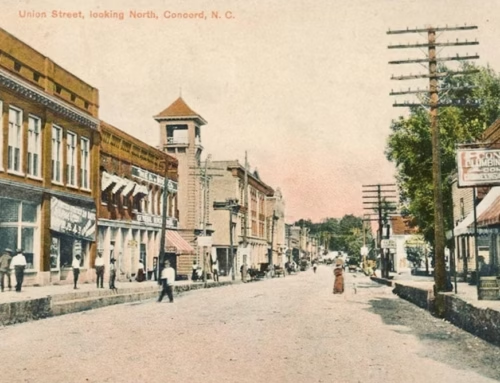
The Hice brothers, Conrad, Jacob, Leonard, and George, were four such men who served in the Mecklenburg Militia in the Salisbury Military District, which covered Mecklenburg and Rowan counties in the western half of North Carolina. Conrad Hise served as Captain of the Mecklenburg Militia. They hailed from the German-speaking St. John's Lutheran Church community (neighbors of my Misenheimer ancestors), in what would become Cabarrus County, between Concord and Mount Pleasant.
Before 7 October 1780, the Patriots had little success. After abandoning operations in the north, the British strategized to secure control of the southern colonies of Georgia, South Carolina, North Carolina, and Virginia. They captured the State of Georgia and reinstated it as the Royal Colony of Georgia. One of the worst American defeats of the war occurred at the Siege of Charleston in May 1780 (see Golden Nugget, Fall 2023, p. 21). The members of South Carolina's Patriot government were exiled, and the governor fled for sanctuary in North Carolina. The British held most of the Carolinas' Continental forces in prison ships in Charleston Harbor. In a victory at the Battle of Camden on 16 August 1780, they captured Salisbury Military District Brigadier General Griffith Rutherford. It honestly looked as though the "Cause of Liberty" was on its last leg. Hope faded fast as the British appeared unstoppable.
The British General Lord Cornwallis planned to divide and conquer North Carolina on three fronts, a so-called "three-pronged attack." One front called for the British Army's Eastern Division in Wilmington to attack at Cross Creek (now Fayetteville, NC). A second front called for sending a detachment, under the command of Major Patrick Ferguson, into the western North Carolina foothills near Quaker Meadows (now Morganton, North Carolina). Major Ferguson had two primary tasks: 1) Recruitment of men favorable to the British Crown, and 2) protecting the British Army as he attempted to establish a permanent military outpost. The third front was a military outpost in Charlotte, following the Battle of Charlotte on 26 September 1780. The subsequent occupation of Charlottetown would be the undoing of the British Crown Forces.
A historic meeting of the Mecklenburg Militia and a group of backcountry Patriots called the Overmountain Men occurred on 30 September 1780 at Quaker Meadows. Joined together in a formidable fighting force, the combined strength of the Mecklenburg Militia and the Overmountain Men organized to lead an attack against Ferguson.
After the Battle of Charlotte, the Patriot militia, under the command of General William Lee Davidson, launched a daring campaign to sever communication and supply lines to Cornwallis and his army. Recognizing the importance of disrupting the British chain of command and isolating their forces, the militia employed swift and decisive tactics. Through ambushes, raids, and sabotage, they effectively crippled the British logistical operations, cutting off vital lines of communication between Cornwallis's main force and his outlying garrisons. The cutting off of communication and supply lines not only hampered British operations but also bolstered patriot morale and support throughout the region.
The Hises' German-speaking Mecklenburg Militia Company was likely assigned to work with the larger German-speaking Militia in Rowan County along the Catawba River, where they guarded the river against German Loyalists and British express horse riders trying to get letters of communication to General Cornwallis. When Ferguson sent a letter to Cornwallis to request additional British troops at Kings Mountain, it was intercepted by the Patriot Militia.
A determined band of Patriots known as the South Fork Boys (because they lived on the South Fork of the Catawba River in Gaston, Lincoln, and Cleveland counties) pursued Ferguson and joined the Mecklenburg Militia, Overmountain Men, and other Patriot units surrounding the Loyalist force at Kings Mountain.
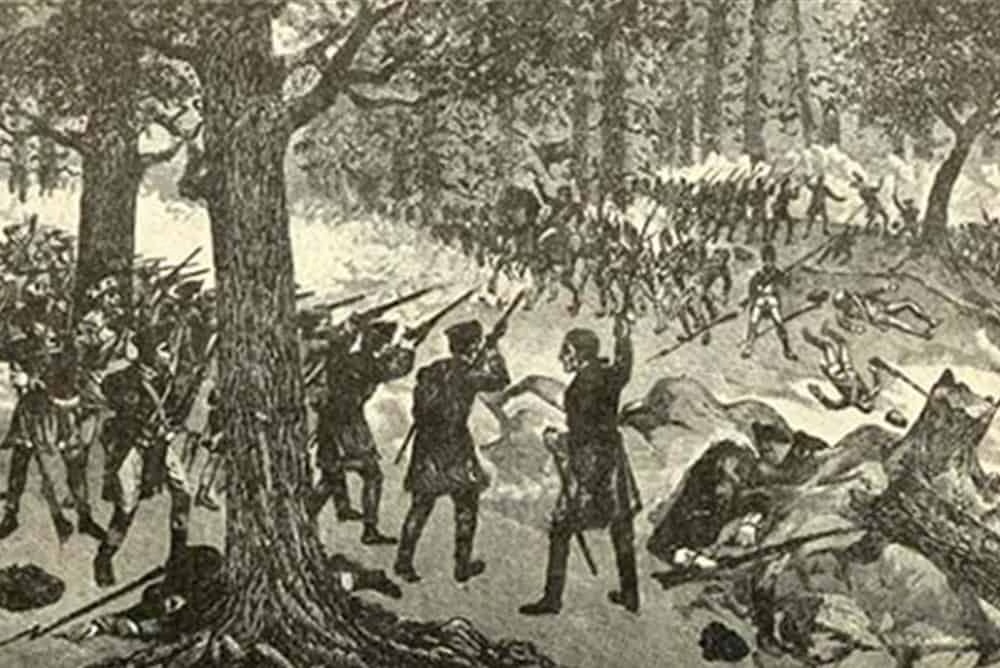
On 7 October 1780, the fierce firefight at Kings Mountain pitted 900 Patriots against the Loyalists and Major Patrick Ferguson. Ferguson, nicknamed "Bull Dog" by his men, came up against the Overmountain Men, who were described as "more savage than the Indians." As the battle commenced, Major Ferguson miscalculated his foes. Lasting only an hour, the Americans fought with merciless fervor. Disregarding the British surrender, Americans continued to slaughter Ferguson's force. Upon the eventual close of battle, over 200 Tories lay dead, including Ferguson. Another 160 Tories lay wounded, and roughly 700 prisoners were taken.
In the end, the patriots emerged triumphant, their victory a testament to the power of unity and resilience. The rout of the British Loyalist troops was the first significant setback for Britain's Southern Military Strategy. It started a chain of events that would culminate in Cornwallis's Surrender at Yorktown. The Battle of Kings Mountain had turned the tide of success, breathing new life into the cause of American independence.
The Hise brothers were the sons of Jans Jerg Hise (1719-1794) and Fannie Mary Jacobs Moyer (1722-1800).
Capt. Conrad Hise, Sr. (1740-1816), was born in Rowan County, North Carolina. He married Sophia Charlotta Specht about 1772. They were the parents of at least six sons and seven daughters. The family was associated with St. John's Lutheran Church. He died on 7 October 1816, in Burke, North Carolina, at the age of 76.
Jacob William Heiss was born in 1752 in Rowan, North Carolina. He married Jenny 'Jincey' Seaton in 1775 in North Carolina. They were the parents of at least five sons and seven daughters. He lived in Franklin, Tennessee, in 1820. He died on 11 January 1821, in Haywood, North Carolina, at the age of 69, and was buried in Haywood, North Carolina, United States.
Leonard Hise, Sr., was born on 11 January 1756 in Rowan, North Carolina. He married Mary Starnes. They had at least five sons and three daughters. He died in 1845 in Haywood, North Carolina, at the age of 89 and was buried in Spartanburg, South Carolina.
George Hise was born on 11 January 1756 in Mecklenburg, North Carolina. He married Catherine Stanninger on 14 February 1780 in North Carolina. They had at least two sons and four daughters. In 1790, he lived in Rowan, North Carolina. George died on 9 November 1846 in Burke, North Carolina, at the age of 90.
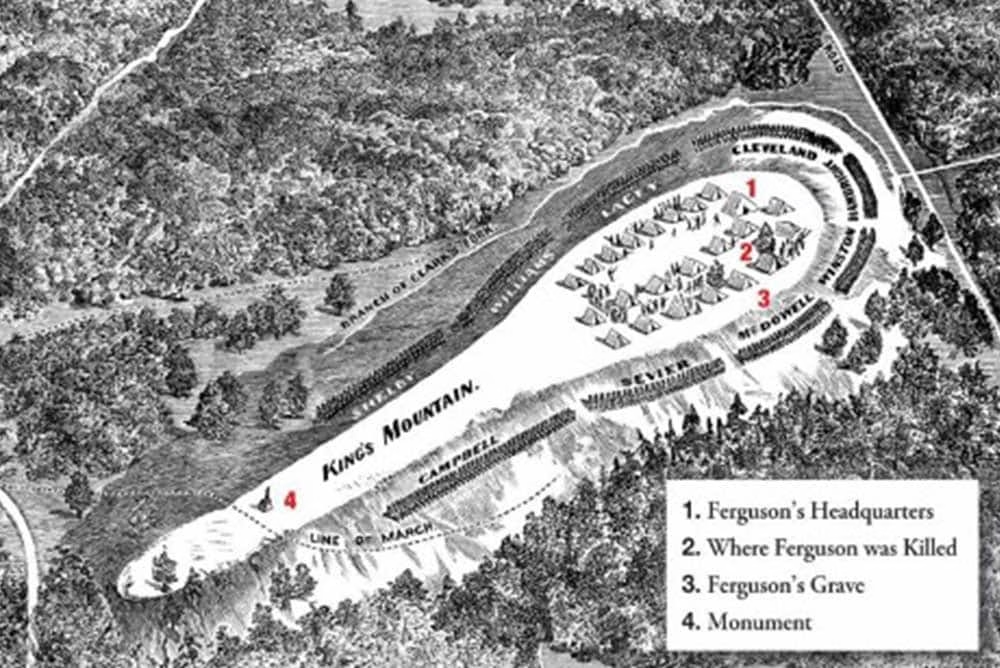
Diagram of the Battle of King’s Mountain
This “Diagram of the Battle of King’s Mountain,” shows the 1,000-ft. ridge where Major Patrick Ferguson and his Loyalists were attacked by Patriot riflemen from the wooded slopes. Lyman Copeland Draper, King’s Mountain and Its Heroes: History of the Battle of King’s Mountain, 1881.
transcriptions of military pensions
The following are transcriptions of the military pensions of Conrad Hice, his brothers Jacob Hise, Leonard Hise, and George Hise, and one of the men who served with them in the 2nd North Carolina Brigade at the Battle of Kings Mountain, South Carolina:[1]
Conrad Hise (Hice) Pension Application, W4453
State of Georgia } Dade County } S.S. On this 15 day of January in the year of our Lord one thousand eight hundred and fifty three personally appeared before the subscriber an acting Justice of the Peace in and for said County, Mrs Margaret Willhite aged eighty seven years past and being duly sworn according to Law doth on oath make the following affidavit That she was born in North Carolinia and was well acquainted with Conrad Hise, who was a Soldier in the war of the Revolution that she knew him to be in the Servace of, the people against the torys, that he was in the Battle of Kings Mountain [SC, 7 Oct 1780] and in servace before that time that she remembers well of his service as a Captain in the Revolution that he raised his Company in the neighborhood in which affiant lived and he was called Captain Conrad Hise in Mellingburg [sic: Mecklenburg] County North Carolinia and affiant thinks he served a considerable time as a Captain & remember of him serving several times as captain and knows that he served as a private for a long time, before he was made a Captain, that she affiant was well acwainted with him and knows that he was in the servace for a long time in the war of the Revolution, bouth as a private and as a Captain and at the time he entered the Servace and as earley as affiant can recolect Conrad Hise above stated was married, and was living at the time of his servace as a private and captain with his wife Sophia Hise who died in the County of Franklin Tennessee. She affiant is confident that Conrad Hise was married at the time of the Battle of Kings Mountain and that he was in that Battle, that she rembers that Fred Fisher [possibly Frederick Fisher, pension application S20364, wounded at Kings Mountain] and Henry Henager [Henry Henigar] were killed at the Battle of Kings Mountain and that Conrad Hise and his Brother Leonard Hise [Leonard Hise (Hice), S8713] were out together and that Leonard Hise afterwards drew a pension for services, and lived in Burk County North Carolinia, affiant could name many that were in the servace with Conrad Hise in the Revolution. She is confident that he served as a Captain. She rembers the Horse he rode when out as a Captain, and also that when he was out he was riding and all the servace he did was a horse back for he started from the house of affiants Father, with several others, and also where he went as a Captain most of his Company went from the neighborhood in which affiant then lived, and they were mostley Dutch [i.e. German] Settlers [in the Saint Johns Lutheran Church community which in modern day geography is between Concord and Mount Pleasant, N.C.] that were with him in the Servace, and at this time Conrad Hise and Sophia wer living together as man and wife and continued so to live up to the death of Conrad Hise above stated. Affiant remembers will of all the above service and she cannot be mistaken in the service of Conrad Hise nor of his marriage with Sophia Speck before the War of the Revolution. [signed] Margaret Willhite State of Tennessee } Franklin County into the servace as Captain of this Compy of Horse as was at his house often while he was in the Servace and stayed with his wife, while he was out fiting the Torys, and affiant remembers well that he wore a uniform and on one occation when he came home after an absense of several months he was slightly wounded and a bullett had passed through his coat, and that he had lost his horse, and returned with another and this horse he retained for several years after the war and would not let him work. Affiant also remembers that Capt Hise above stated told her and her father that he was in the Battle at Kings Mountain and at Gilferd Court House [sic: Guilford Courthouse NC, 15 Mar 1781], and affiant remembers well that Captain Hises wife was in a great distriss for fear her husband was killed when they heared of these battles. She remembers well also that he had mostly dutch in his company and that he was a dutchman. Affiant would further declare that Captain Conrad Hise above stated left a widow Sophia Hise and she was his wife when he was in the servace and the person she alludes too as his wife the one the affiant stayed with while he was in servise that she is the Identical Sophia Hise who died in October eighteen hundred and fifty in Franklin County Tennessee and affiant would further declare that Conrad Hise who now lives in Franklin County Tennessee is the son of the Identical Captain Conrad Hise above stated and of Sophia Hise above stated [signed] Katy Wever State of Tennessee } Franklin County…
Jacob Hise Pension Application, R5045 fn13NC
Jacob Hise who was a Soldier in the war of the Revolution that he served in the State of North Carolina and went from Washington County what is now Tennessee that he was at the Battle of Kings Mountain and affiant cannot specify the amount of Service performed by his father Jacob Hise above stated but thinks he served for a considerable time in the war of the Revolution, but for the facts of service he affiant must refer to the proofs accompanying this Declaration and to the proof otherwise furnished. Affiant would further declare that his father above stated died in the year 1820 on the 11th day of January leaving affiant's mother a widow, and her name was Jeney [could be Jessey] Hise, and that she never intermarried but continued the wife of Jacob Hise above stated up to the day of he [her] death which occurred on the 26th day of August 1846.
His father, Jacob Hise as above stated, Affiant would further declare that his father had three Brothers Conrad Hise, George Hise and Leonard Hise and that he has understood that they were all in the war of the Revolution
Leonard Hise (Hice) Pension Application, S8713 f26VA
I was in a 3 months tour of service under Volunteer Captain James Dysart (who although a Colonel) acted as Captain in Colonel Campbell's Regiment at the battle of King's Mountain in October 1780. When we went into the battle, I was commanded by Captain James Dysart where I was dreadfully wounded. I received two balls in by left arm and it was broken. We were fighting in the woods & with the assistance of my comrades who would push my bullets down, I shot three rounds before I was shot down & I then received a bullet through my left leg. The fourth bullet I received in my right knee [?]2 which shattered the bone on of my right thigh & brought me to the ground. When on the ground, I received a bullet in my breast & was bourn off the ground to a Doctor & on the next day I was discharged by my Captain James Dysart which said discharge was the one lost by Colonel David Newland as shown by his affidavit hereunto appended (A). At the battle of King's Mountain I shot 16 rounds as I think. The reason of thinking so is that on the morning before the battle I run [?]3 100 bullets & after the battle I missed Sixteen. The way that I fought after my left arm was broken was to rest my rifle against a tree & take sight & generally the man I aimed at fell; whether my bullet brought the enemy down or not I cannot say for many were as good marksmen as I, we being mounted Rifleman & I was carried to Dr. Frederick Fisher's near Salisbury, N.C., where I stayed two years before I was able to get home.
last tour of Duty, the battle of King's Mountain, I was a mounted Rifle man. There were never any regular officers where I served that I now recollect. In my four first tours against the Indians, we never were under the command of a higher officer than Captain. At the battle of King's Mountain, Col William Campbell commanded the Regiment to which I belong. Col. Cleveland's [Benjamin Cleveland's] Regiment or a part of it were in the battle: also Col McDowell's [Joseph McDowell's] men from Burke [County]. I also recollect that the present General William Lenoir of Wilkes [County] was in that battle.
George Hise (Hice) Pension Application, R5044 fn12NC
State of Georgia Union County: On this 25th day of October A.D. 1853 personally appeared in open Court before me John S Fain ordinary of the County of Union and State of Georgia, Jacob Hise and George W B Hise residence of the County of Gilmer and State of Georgia, who being duly sworn according to law declare That they are sons of the identical George Hise was a private in the Company commanded by Captain Martin Fifer [Phifer] in the Regiment commanded by Colonel __ under the command of General Rutherford in the Revolutionary War and that he served a six months tour under the command of Colonel Campbell in the same War, above named prior to the services above named. That the said George Hise died on the 9th day of November A.D. 1846. That their Mother named Catharine Hise died on the 11th day of August A.D. 1838. That they were residents of the County of Cabarrus and State of North Carolina and that they resided there 26 years, and that they were married on the 14th day of February A.D. 1780.
George W B Hise who being duly sworn according to law deposeth and saith that the following is a true Copy of the Family Record of George Hise deceased named in the annexed declaration, viz., George Hise joined with in matrimony with Catherine Starringer [could be Staninger] the 14th day of February in the year of our Lord 1780. Catharine Hise wife of George Hise died August the 11th day 1838 in the morning and George Hise died November the 9th Day 1846 and that said Family Record was all written by said George Hise himself with the exception of the death of himself and his wife Catherine Hise, and that the last mentioned record was made by deponent. Sworn and subscribed before me on this 6th day of January 1854.
Joseph Starns (Starnes) Pension Application, S7600 f31VA
Tour of Duty: 4th Fourth was served under Captain Neal in Colonel Wm Campbell's Regiment Term of Service four months or over. Went to King's Mountain & was in that battle [October 7, 1780] Furgerson [sic Patrick Ferguson] of the British Army was killed after the battle was over Campbell left him to take care of the wounded for 2 months Captain Neal did not go into the Battle with them for he had lost his horse & Neil's company was commanded a young man of the name of Shelby not Colonel Shelby – in or about 1780 he was a volunteer in this expedition.
When I went under Colonel Campbell to King's Mountain I was a mounted volunteer & when I went to the Cherokee nation under Colonel Arthur Campbell I was also a mounted volunteer. After that often out as a volunteer as a Scout vs. Indians & Tories but never again in Regular Service. Question 5. State the names of some of the regular officers who were with the Troops where you Served, such Continental and militia regiments as you can recollect and the General circumstances of your Service Answer I was under Colonel Campbell at King's Mountain I think it was in 1780 month of September Colonel Cleveland of N. C. militia commanded the Right wing and Col. Sevier of the N. C. militia from over the mountain now Tennessee commanded the Left wing of the Army. Colonel Campbell of Virginia Troops marched up in front we surprised & took their picket guard without a noise then a man named Philip Grier a messmate of mine stood next to me on the left side shot a man who came off from the British Guard into the wood, this made the enemy's Guard retreat to the main body – we advanced on them before they could form & gave them a fire and before we could load again the British formed & charged on us and we retreated across a little Hollow & loaded & then advanced on them & kept up such a constant fire for 40 or 50 minutes that they never made us retreat again, but we stood still advancing upon them till the end of the battle, I understood that the principal part of the force of the Enemy were Tories. I saw Ferguson of the British Army lying dead twas said he had 7 bullets shot through him.
Question 6 Did you ever receive a discharge from the service & if so by whom was it given Answer I never received a written discharge for I lived within 3 miles of Col. William Campbell & when my services was no longer required he would tell me to go home until called or from the expiration of the year 1778 up to the close of the war I stood as a minute man and served very often whenever the Indians or Tories troubled us I kept a good horse and thought myself bound to protect the frontier & we did so although many lives were lost.
Fourth tour of service was for four months under Captain Neal of Colonel William Campbell's (was a horseman) went to & was in the battle of Kings Mountain – he thinks in 1780, discharged & got home just about Christmas.
State of North Carolina Burke County: This day came Leonard Hice before me the undersigned Justice of the Peace for the said County and made out that he knew Joseph Starns did serve several towers [tours] against the Indians and Tories and that he knew also that he was in the battle at Kings Mountain under the command of Colonel William Campbell and helped him off of the battle ground after himself was wounded – and that it was in 1780 – Sworn to and subscribed the day and date above written.[October 6, 1832] S/ Leonard Hice, X his mark
[1] All transcriptions are from Southern Campaign American Revolution Pension Statements and Rosters, transcribed by Will Graves (unless otherwise identified), https://revwarapps.org/. Original spelling is maintained throughout.