Get To Know Our New Executive Director
Q: Please tell us briefly about your background and what inspired you to work in history and preservation.
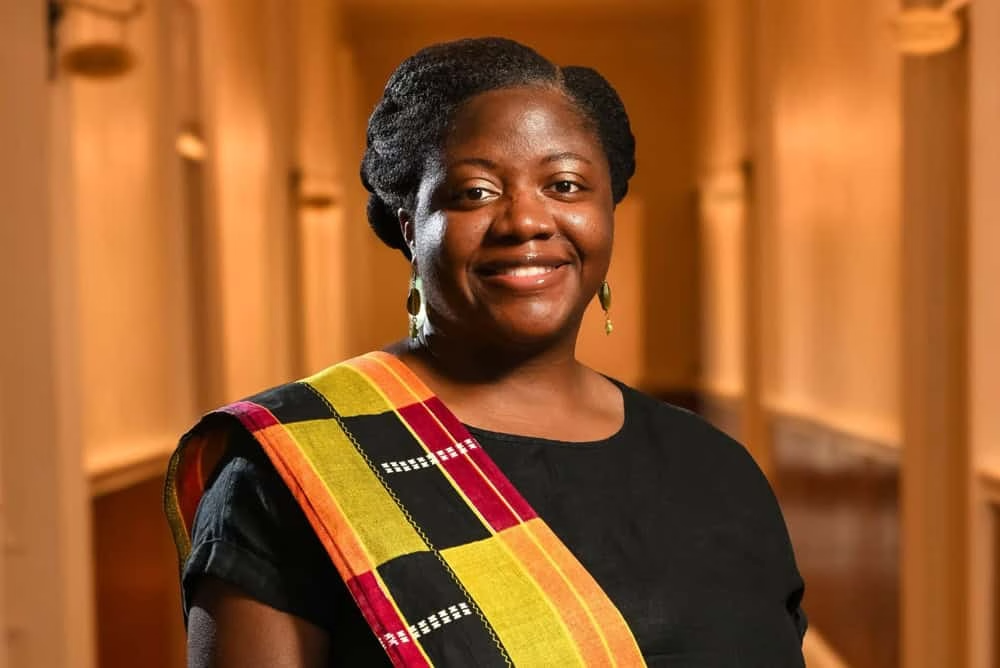
A: I am a Charlotte, North Carolina native. My family inspired my career path as a historian. These deep and unique roots have maternal and paternal sides, hailing from Orangeburg, South Carolina. They make me who I am and continue to guide me in more ways than one. My family is full of Historically Black Colleges and Universities (HBCUs) graduates. Spending time on and off campus centered around these institutions ignited a fire in me. Not only did I admire the graduates of HCBUs, but I also fell in love with their infrastructure.
For these reasons, I attended Virginia State University, where I majored in history and minored in philosophy. I had an opportunity to work with special collections but had no clue about the world of public history. I knew about preservation, but this was a foreign concept to me. What was I going to do with a history degree? Most would assume teaching. However, the work I could do in the university archives opened up a new world. In special collections, I gained experience cataloging, creating exhibits, giving tours to local organizations, and digitizing. These skills introduced me to public history. Once I found the name of my career, I ran with it. I just knew that’s what I wanted to do. That’s what started me on my way. It led me to graduate school and a full public history degree.
While I was in Washington, D.C., there was a lot of opportunity to work in preservation. I interned with the National Archives, preserving film. I cleaned and spliced together old film reels. I worked on rare films from early Hollywood. I didn’t realize the value of learning that. Only a handful of people in the building at that time could do that. I volunteered for the National Parks Service. That helped me learn more about exhibitions and tourism. Those two experiences led me to historic preservation and interest in local history.
It even carried into my personal life. I became very interested in looking at North Carolina county pictorial books in Charlotte. I stumbled across a pageant queen who graduated from Second Ward High School in about 1960. I started doing my oral history project. That led me to do an oral history project with Barber-Scotia College [in Concord]. I just wanted to know how it impacted the City of Concord when it closed down and what it did to the people. I was interested in that qualitative part – getting the stories of the people. What were they feeling? What did they do?
Q: Was your project with Barber-Scotia College your introduction to Cabarrus County history?
A: It wasn’t my introduction but my first personal connection with Cabarrus County. I had read about it and attended events, but it was my first boots-on-the-ground research. My topic was alumni giving and the economics of minority-serving institutions in small college towns.
Q: What drew you to the Historic Cabarrus Association?
A: I had reached my wit’s end, seeking an opportunity that welcomed my interest in historic preservation. Finding a position in historic preservation in Mecklenburg County was quite challenging. I had to sit down and pray about what I wanted. I concluded that my searches were not working out because I wasn’t looking for exactly what I wanted. I boldly started looking for positions that explicitly mentioned historic preservation.
Historic Cabarrus popped up within a week while looking at an event for another historical society. I decided to check the organization and see if they had anything open. Sure enough, I saw an open position. I thought I had reached a certain point in my career where maybe I could go forward, but I wasn’t sure I was ready. I ran into the position again on LinkedIn. When I saw it a third time, I thought, OK, let me put in for it. When I heard back within a few days, I thought, alright, this can be a thing.
Q: What has been the most rewarding aspect of your career so far?
A: While a grad student at Howard University, I had an opportunity to honor the Swanns of the court case Swann vs. Charlotte Mecklenburg (Board of Education, 1971) about integration. I tested this court case throughout school and considered it in my book (textbook). I had the opportunity to honor them as living legends, interview them, and share their experience. The HBCU that inspired my family – my father and siblings graduated from Johnson C. Smith in Charlotte – I would say that the event, planning with the community and alums, was an experience I enjoyed – North Carolina history and programming.
Q: What are some interests that you have outside of work?
A: I am an avid museum-goer. I love interactive museum exhibitions. I have to take my two little besties with me (her children). I love being outdoors. As I get older, I understand that movement in any form is excellent. I am a crafter. That’s my thing. I have a Cricut machine. I love family and intimate settings. It doesn’t take much for me to have a good time.
Q: Although you have only been with HCA briefly, you have been working on strategic planning. Have you developed some key goals for the next few years?
A: First, I am incredibly excited by the opportunity to lead HCA during its next phase of growth and relevance to the community. Reconnecting with our supporters and neighbors is key these next few years. This organization has been here for quite some time. In the first few years, it has been about connection. Cabarrus County is a fantastic place to hone in on the people and families.
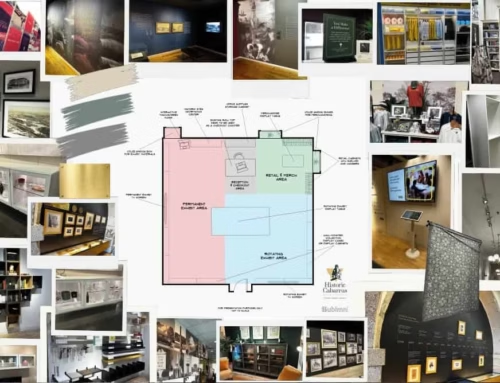
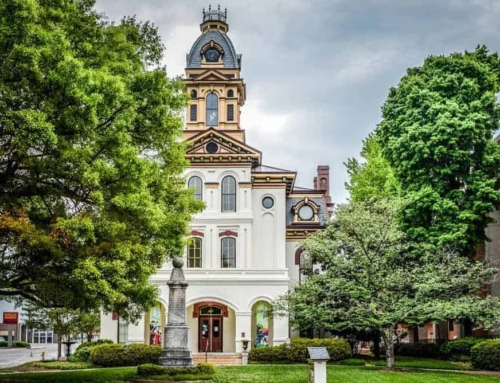
In addition, we are working to share our collection and reimagine the exhibit space (at the historic courthouse). There is a wealth of information on the board. The board truly understands the importance of protecting historic structures. Their extensive experience and passion for preservation make them a great team to do this work. Saving buildings is one of the most important things we can do for preservation because it gives us a direct and visible link to our past. We can provide the platform to share that.
I am looking forward to increased programming and events and capitalizing on everything that is going on outside our doors—the revitalization of downtown Concord. It is a fantastic period—a growing economy, more people moving in. We should be a part of showing that evolution.
Q: How can HCA engage with the community and increase interest in historic preservation?
A: It begins in this room (at the historic courthouse) – reimagining this space and what is in it. In my first full week, there was much curiosity about our exhibit space from individuals passing by. Every day I’ve been here, someone asks what we will do with this space. Historical societies have shown a concerted effort to strengthen interactive programs to give visitors a more complete and accurate experience. Historic Cabarrus hopes to engage the public with small deposits of preservation tips they can do at home with their families. These could include learning to preserve family photos or record an oral history.
Q: Can you discuss the importance of partnerships and collaborations in achieving our organization’s mission?
A: As the Cabarrus County region continues to transform and expand, it’s critical that we understand how we got to where we are today. Through diverse programming and working alongside projects like Meadowview and Boxwood Manor, the Historic Cabarrus Association will offer a singular place for our community to understand its history. I think about Gibson Mill, how that space has transformed, and the many other stories in Cabarrus County. The most significant outcome is that partnerships call for community and access for everyone to benefit. Cultivating relationships with other historical societies, both in and outside Cabarrus, means supporting one another, creating programming opportunities, and understanding new trends within historic preservation.
Q. What are some ideas that you have regarding fundraising and donor engagement?
A: Again, it all starts with relationships. I want partners and sponsors to be excited about what we are doing. The only way to do that is to keep our wheels turning with programming and get them involved—ensuring the relationship is off to a good start and building from there. A lot of fund development, not necessarily just fundraising. Looking at grant opportunities.
Q: How would you describe your leadership style, and how will you engage with the board of directors?
A: This is by far the largest team I have worked with. Over my career, I have had the opportunity to lead smaller teams. My leadership style is open-door. I am huge on communication and consistency. I need that type of culture. I want to know what the board is thinking. They all have amazing ideas and want to share them. I want to be open to new ideas. I’m big about processes and intention. I’m about putting things down on paper to get started and ensuring we have the tools to do so. I want to make sure we have an understanding of goals and expectations.
Q: Have you noticed any trends in historic preservation and with historic organizations?
A: We are definitely in a digital world. But there is a benefit to both digital and having an in-person space. There are still people who want to have hands-on experience. I understand the benefit of it (digital exhibits), but many are tired of overly producing things. Some museums and organizations use the same script, and the marketing feels the same as far as reaching out to their constituents and patrons goes. People may say, “I’m tired of the digital world. I have time today or on open weekends. I want to see what they are doing.” That is what is unique about this space (the HCA office at the historic courthouse). I envision it to be a self-guided opportunity to come in and see what we have, touch it, and read something for yourself – to bring people back as we grow. Programming is a trend that is coming back.
Historic preservation is finding new items, pieces that have been neglected or missing for so long, and doing evaluations. That is of interest to the community. Adaptive reuse. Reimagining spaces. I do see that trending a lot. A lot of organizations are finding new ways (to save historic sites) to generate revenue. It’s a work in progress. HCA hopes to be more involved in that in the future.
Q: What advice would you give someone interested in exploring a historic preservation or nonprofit management career?
A: Volunteer. If you have some curiosity, volunteer. Many individuals underestimate how transformational volunteering can be. Over my career, I asked about volunteering if I read something on a website and just wanted to know something about historic preservation. Learn about different avenues you can pursue. That experience is valuable. You have to start somewhere.