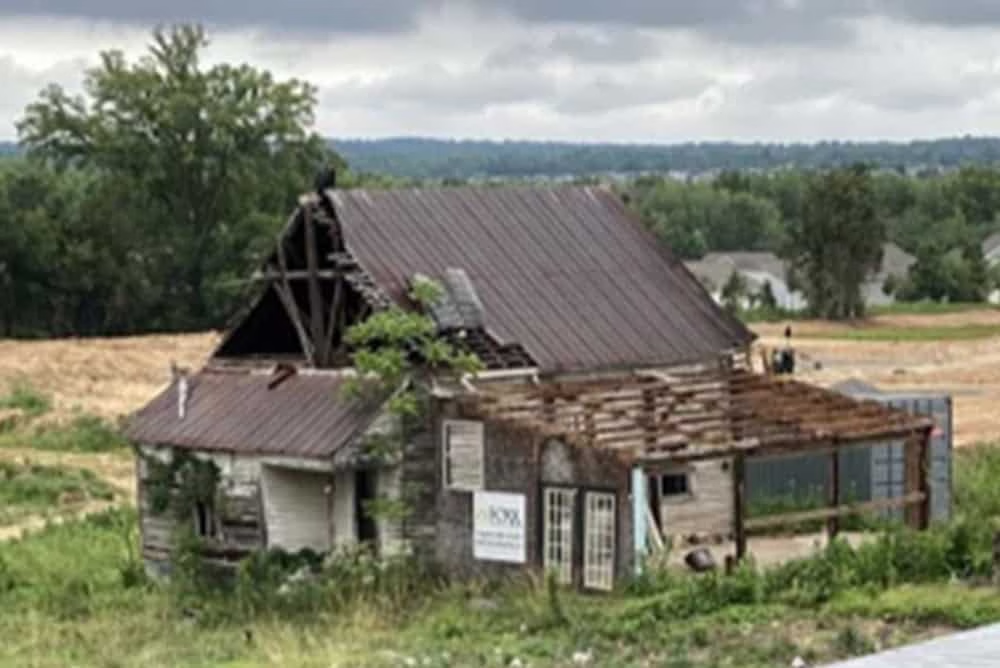
Historic Cabarrus Association Leads Effort to Preserve Meadow View School
A treasured piece of Cabarrus County's African-American history is one step closer to preservation. The Meadow View School, built around 1890, is once again on the move — but this time, its destination marks the beginning of a permanent future rooted in restoration and remembrance.
A Historic Schoolhouse Finds a New Home
The Historic Cabarrus Association (HCA) recently relocated the disassembled Meadow View School from its temporary home behind the Academy Recreation Center on Academy Street in Concord to a secured lot off Lucky Drive. The move marks the latest milestone in HCA's long-term mission to restore and preserve the historic African-American schoolhouse, which once served as an essential center for education and community life.
The relocation was made possible through a collaborative partnership between HCA, Niblock Homes, and the City of Concord, with ongoing support from community leaders and preservation advocates. Plans are now underway to reconstruct the Meadow View School near a replica of the Red Hill Tavern, adjacent to the 1757 Phifer Family Graveyard on Lucky Drive. Remarkably, the original Red Hill Tavern is believed to have been mentioned in George Washington's diary during his southern tour.
Building Toward Preservation
According to HCA Executive Director Dr. Shanaee Bodrick, the project's goal is twofold: to stabilize and rebuild the physical structure of Meadow View while ensuring its legacy endures as an educational and cultural resource for future generations.
"The Meadow View School tells a critical story about our community's past," said Dr. Bodrick. "It reminds us of the resilience, self-determination, and commitment to education that defined Black communities in Cabarrus County during the late 19th and early 20th centuries."
Once rebuilt, the restored school will serve as a center for learning, reflection, and historical interpretation, where visitors can explore the educational experiences of rural African-American students during segregation.
The project, initially spearheaded by HCA board member Alex Porter and former executive director Ashley Sedlak-Propst, represents years of research, planning, and grassroots effort. Early startup costs are estimated at $500,000, and HCA has launched a GoFundMe campaign to support the reconstruction and restoration process.
Uncovering the Story Behind Meadow View
Dr. Bodrick's research has uncovered significant details about the African American educational landscape in Cabarrus County before the 1950s. Before public resources became available, education for Black children was often provided through African Methodist Episcopal Zion (AME Zion) churches.
Among the early schools were Bethel, Ebenezer, Rock Hill, Pleasant Grove, and Brown Hill, all of which played key roles in educating generations of African-American students before the creation of formal school systems.
By the early 1900s, there were more than 20 rural Black schools across Cabarrus County, including Meadow View, which predates the Rosenwald Schools that later transformed Black education across the South.
One notable educator connected to the school was Lucille Wyke (later Bost), who served as both principal and teacher at Meadow View before continuing her career at Shankletown and, later, at the Harrisburg schools. Wyke's story, along with those of her students and colleagues, will be central to the future exhibit once the school is reconstructed.
Honoring the Past, Inspiring the Future
When complete, the restored Meadow View School will offer more than a preserved building — it will be a living classroom for exploring themes of equity, resilience, and community.
"This project is about more than bricks and boards," said Dr. Bodrick. "It's about making sure the stories of those who built, taught, and learned here continue to be heard."
The Historic Cabarrus Association invites the community to stay engaged as preservation efforts move forward.