Barber-Scotia College: From Historic Beginnings to a Triumphant Reopening
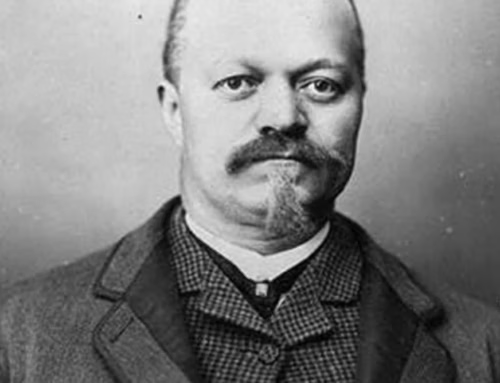
Education has long been the cornerstone of opportunity — a path to self-determination and upward mobility. For formerly enslaved Americans and their descendants, institutions of learning became symbols of progress and freedom. In Concord, that vision took shape in January 1867, when Reverend Luke Dorland, under commission from the Presbyterian Church (USA), founded Scotia Seminary—a school dedicated to training African American women in education and social service.
"Head, Hand, and Heart"
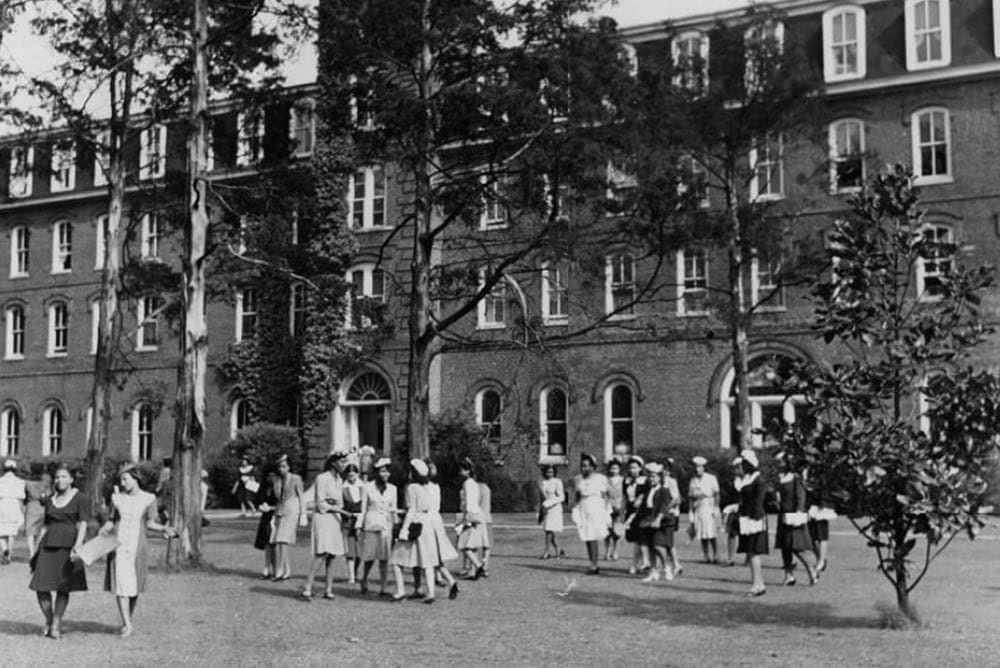
From its earliest days, Scotia's mission emphasized developing the "Head, Hand, and Heart," words that remain engraved on the cornerstone of Faith Hall. Over the decades, the institution evolved, reflecting both the changing needs of its students and the broader shifts of American history. It became Scotia Women's College in 1916 and later merged with Barber Memorial College of Anniston, Alabama, in 1930. Two years later, the merged institution adopted the enduring name Barber-Scotia College.
By the mid-20th century, Barber-Scotia had earned recognition as a Class "A" Junior College and later expanded to a four-year institution, granting its first bachelor's degrees in 1945. In 1954, with an amendment to its charter, the college officially opened its doors to students of all races and genders, reaffirming a commitment to inclusivity and equity that remains foundational today.
Despite losing its accreditation in 2004, Barber-Scotia's spirit of perseverance never waned. The college continued its mission through community engagement, spiritual leadership, and a steadfast connection to the Presbyterian Church (USA). Now, more than 155 years after its founding, Barber-Scotia is turning the page to a new chapter — one defined by renewal, growth, and hope.
A Historic Homecoming: Students Return to Campus
For the first time in over a decade, students are once again calling Barber-Scotia College home. On a joyful Friday morning this August, families traveled from across the nation — from California to Florida — to move into campus housing, marking a milestone in the institution's long history.
In his announcement, President Dr. Chris Rey introduced the arriving class as the "Historic 117," a nod to the 117 students who represent the school's first returning residential cohort. Of those students, 75 are living on campus in Faith Hall, the same residence hall whose cornerstone bears the college's guiding motto.
Classes begin for the Fall 2025 semester on August 25, with the college now offering five degree programs:
- B.A. in Theology
- B.A. in General Studies
- B.S. in Business Administration
- B.S. in Organizational Leadership
- B.S. in Information Technology
In addition to its academic expansion, Barber-Scotia has partnered with community organizations to launch a trade school, offering training in high-demand fields such as carpentry and HVAC work. The college is further expanding its athletic offerings, joining the New South Athletic Conference and preparing to field its first-ever football team in 2025, along with baseball, basketball, and women's flag football.
A Vision for the Future
Under Dr. Rey's leadership, Barber-Scotia has resolved long-standing debts with the City of Concord, insured all campus facilities, and is preparing to apply for accreditation — a critical step toward restoring federal financial aid eligibility. Rey expects the process to take 15 to 18 months and remains confident in the college's progress.
With optimism rising and students once again walking the grounds of this historic campus, Barber-Scotia College's story of resilience continues. From its founding as a post-Civil War seminary for young women to its transformation into a modern institution of learning, the college stands today as a testament to faith, perseverance, and purpose — a living symbol of education's power to change lives and communities.
The "Historic 117" marks a new beginning. Still, the mission remains unchanged: to educate the head, hand, and heart — and to carry forward a legacy more than a century and a half in the making.